
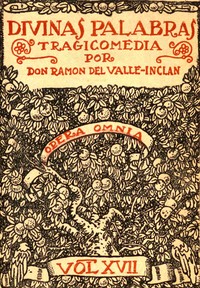
Divinas palabras : Tragicomedia de aldea by Ramón del Valle-Inclán
If you're tired of stories that play it safe, let me introduce you to Ramón del Valle-Inclán's 'Divinas palabras.' This isn't a gentle read. It's a punch to the gut dressed up as a village play, and it's utterly fascinating.
The Story
The plot revolves around a macabre family business. Mari-Gaila and her husband, Pedro Gailo, travel the countryside with their nephew, a hydrocephalic child they call 'the Idiot.' He can't speak or move, and they display him like a carnival attraction, begging for alms. When Pedro's sister (the child's mother) dies, a vicious fight breaks out. Who gets the Idiot? It's not about love or care. It's about who gets to keep the money he brings in. The battle pulls in a cast of villagers—a drunken sacristan, lusty women, and hypocritical moralists—all circling this helpless boy like vultures. The story builds to a shocking, almost surreal climax where sacred words are twisted to justify profane acts, blurring the line between prayer and curse.
Why You Should Read It
Valle-Inclán doesn't judge his characters. He shows them in all their miserable, hilarious, and terrifying glory. You won't find heroes here, just people warped by need and superstition. The dialogue crackles with life, mixing coarse peasant speech with flashes of strange poetry. What got me was the book's brutal honesty about how easily faith can be used as a weapon and how poverty can strip away pretense, leaving only our most basic instincts. It's a grim picture, but it's painted with such savage energy and dark humor that you can't look away.
Final Verdict
This book is perfect for readers who love gritty, character-driven stories that explore the darker corners of human nature. Think of Flannery O'Connor's Southern gothic, but set in rural Spain. If you enjoy authors who aren't afraid to be ugly, unsettling, or morally ambiguous, you'll find a lot to chew on here. Fair warning: it's not a feel-good story. But if you want a short, powerful play that feels like watching a train wreck in slow motion—one that makes you think long after you've finished it—then 'Divinas palabras' is a must-read.
This text is dedicated to the public domain. Preserving history for future generations.
Thomas Clark
9 months agoBeautifully written.
Mark Garcia
1 year agoBased on the summary, I decided to read it and the plot twists are genuinely surprising. Worth every second.
Mark White
3 months agoHonestly, it manages to explain difficult concepts in plain English. Definitely a 5-star read.
Betty Thomas
1 year agoBased on the summary, I decided to read it and the depth of research presented here is truly commendable. Thanks for sharing this review.





Donna Rodriguez
10 months agoI had low expectations initially, however the content flows smoothly from one chapter to the next. I will read more from this author.