
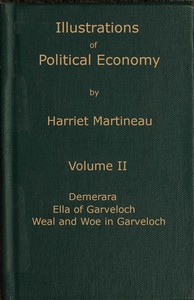
Illustrations of political economy, Volume 2 (of 9) by Harriet Martineau
This isn't a single novel, but a collection of tales where economics is the main character. Martineau uses fictional settings and people to demonstrate the real-world principles she wants to teach. In one story, you might see how a poor harvest affects everyone from the field worker to the city baker. In another, a new machine is invented, and we follow the hope and fear it brings to an entire community. The "plot" is always the same core idea: how individual actions, guided by self-interest and circumstance, create the larger economic realities we all live within.
Why You Should Read It
The magic here is Martineau's method. She makes abstract concepts immediate and personal. You don't just learn about overproduction; you meet the family whose warehouse is overflowing with unsold goods, watching their savings vanish. The arguments for free trade aren't in a political speech; they're in the frustrated conversation between two merchants separated by a tariff wall. Reading this today is a fascinating double experience. You get a clear, story-driven lesson in basic economic ideas that still apply, but you also get a direct window into the anxieties of the early Industrial Revolution. You feel the era's turmoil through its people.
Final Verdict
This is perfect for curious readers who like their history and big ideas served with a strong human touch. If you enjoy authors like Charles Dickens for his social commentary but wish he'd explained the systems behind the poverty he described, Martineau is your answer. It's also great for anyone who finds standard economics texts too dry. Be prepared for writing that's of its time—it's accessible, but the style is distinctly 19th-century. Think of it as a time capsule and a toolkit, all in one: a vivid portrait of a world grappling with massive change, and a surprisingly engaging way to understand the economic forces that still shape our own.
This title is part of the public domain archive. Feel free to use it for personal or commercial purposes.
Amanda King
3 months agoIf you enjoy this genre, it provides a comprehensive overview perfect for everyone. I learned so much from this.
Jessica Moore
2 months agoWow.
Oliver Moore
1 month agoI didn't expect much, but the character development leaves a lasting impact. A true masterpiece.




Andrew Clark
1 year agoGreat reference material for my coursework.