
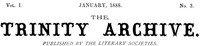
The Trinity Archive, Vol. I, No. 3, January 1888
Let's be clear from the start: this isn't a storybook. The Trinity Archive is a primary source—the real, handwritten (and later typed) magazine produced by the students of Trinity College in North Carolina, which would later become Duke University. This specific issue, from January 1888, is a collection of everything they found important: original poems, short stories, philosophical essays, campus news, and even some dry humor.
The Story
There's no single narrative. Instead, the 'story' is the collective voice of the student body. One page features a serious essay debating evolution and its challenge to religious belief. Turn the page, and you'll find a fictional tale about a lonely scholar or a witty parody of campus life. The editorials argue fiercely for the value of a liberal arts education. The meeting minutes of literary societies show young men (it was an all-male school then) practicing rhetoric and debate. It's a mosaic of their intellectual and social world. You're not following a character's journey; you're listening in on a lively, sometimes heated, dorm-room conversation that happened 136 years ago.
Why You Should Read It
I loved this because it destroys the stereotype of the 19th century as a distant, formal, and boring period. These students are immediately recognizable. They're ambitious, worried about their futures, questioning authority, and trying to make their mark. Reading their earnest debates about big ideas, alongside their silly jokes, makes history feel human. You get a front-row seat to the forming of a modern Southern identity—one grappling with its past while desperately trying to innovate and educate. It’s raw, unfiltered, and far more engaging than any textbook summary of the era.
Final Verdict
This is a niche read, but a profoundly rewarding one. It's perfect for history buffs who want to move beyond dates and battles to hear the actual voices of the past. It's also great for anyone connected to North Carolina, Duke University, or the history of American higher education. Most of all, I'd recommend it to curious readers who enjoy the thrill of archival discovery—that feeling of holding a piece of the past and finding a direct, emotional connection to the people who made it. It’s a short, concentrated dose of real life from another time.
The copyright for this book has expired, making it public property. You do not need permission to reproduce this work.
Mary Clark
1 year agoI came across this while browsing and the emotional weight of the story is balanced perfectly. I would gladly recommend this title.
Charles Lewis
1 year agoUsed this for my thesis, incredibly useful.


Brian Moore
7 months agoAmazing book.