1

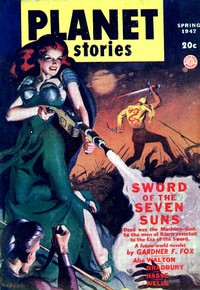
Beyond the Yellow Fog — A Reader’s Guide
16
2
Project Gutenberg
2021
Science fiction; Adventure stories; Space ships -- Fiction; Slave trade -- Fiction
Readers of public-domain and historical texts
Project Gutenberg digital edition
en
Edition facts
Words: 23,666
Reading time: 103 min
Text sections: 3
Source:
Project Gutenberg record #64323
Emmett McDowell's 1947 space adventure follows Gavin Murdock, a disgraced astro-engineer who signs onto a Jovian slaver, the Nova. The narrative shifts from bureaucratic tension to action as Murdock investigates the 'little death'—a creeping yellow fog—while evading pursuers and navigating betrayals aboard ship.
Editorial Edition Score
4.6/5
★★★★★
★★★★★
Calculated from edition completeness, EPUB availability, text structure and catalogue metadata. Not a user rating.
Edition quality
The story opens with a laconic interview: Gavin Murdock, a hardened manhunter, faces a Martian official who scrutinizes his application to serve on a slaver. McDowell establishes voice through clipped dialogue—Murdock's 'Blacklisted' and 'Belted the old man in the nose'—and the Martian's dry, formal tone. The setting, Venusport, is sketched with minimal detail, focusing instead on the power dynamic. The pace quickens as Murdock senses the Martian is stalling, hinting at danger. This early scene uses bureaucratic friction to build tension before the plot shifts to space.
Voice and Dialogue as Characterization
McDowell relies on terse exchanges to define Murdock: his replies are often single words or short phrases ('Sure,' 'Blacklisted'), contrasting with the Martian's elaborate sentences. This laconic style persists throughout the excerpts, even in action scenes. When Nadia Petrovna confronts Murdock with a dart-gun, his response—'It's good to know who your friends are'—is dry and understated. The dialogue rarely reveals interiority; instead, characters' intentions are inferred through what they don't say. The Martian's hesitation and Nadia's tears suggest hidden motives, but the narrative withholds explanation, maintaining a sense of mystery.
Pacing and the 'Little Death'
The phrase 'little death' recurs as a whispered warning, creating an ominous refrain. The pace alternates between slow, tense scenes—Murdock's interview, his search for answers—and sudden bursts of action, like Nadia's assassination attempt. The sixth-day passage marks a lull: Murdock sits on the observation deck, watching pursuers close in, while his thoughts 'wrestled for the hundredth time with the little death.' This reflective pause is interrupted by the sight of rocket trails, then Nadia's arrival, shifting back to interpersonal conflict. McDowell uses these rhythmic changes to keep the reader off-balance, mirroring Murdock's uncertainty.
Setting and Sensory Details
The world is built through specific, sensory cues: glassite desks, plastic vests, dart-guns, and the 'yellow mist' of the title. Venusport is evoked only as a place where Murdock has been 'on the beach,' while the Nova is defined by its decks and atomic shell range. The yellow fog itself is introduced as a whispered threat—'When that yellow mist starts creeping, you'll wish you were dead'—but its nature remains unexplained in the excerpts. McDowell avoids lengthy descriptions; instead, he drops details like 'the three streaks in the void' or 'the hair line of a rocket ship's jets' to create a vivid but economical space.
Readers should attend to how McDowell withholds information: the 'little death,' Nadia's true loyalties, and the Nova's secret drive are hinted at but not resolved in these excerpts. The narrative rewards close attention to shifts in tone—from bureaucratic dryness to sudden violence—and to the recurring motif of the yellow fog, which may be more than a physical threat. The story's brevity (under 24,000 words) suggests a tight, focused plot where every detail counts.
Reader reflection
What did you think of this book?
Answer a few questions and save a private reflection on this device.
Your progress
0
/
10
2
How much did you enjoy the reading experience?
3
How likely are you to recommend this book?
4
How easy was the book to follow?
5
Did the book meet your expectations?
6
What was its emotional impact?
7
Would this book work well in a reading group?
8
Did any part of the book feel personally relevant?
9
Which lesson or insight stayed with you?
10