1

Last Run on Venus — Background and Themes
12
1
Project Gutenberg
2021
Science fiction; Man-woman relationships -- Fiction; Venus (Planet) -- Fiction; Tourists -- Fiction
Readers of public-domain and historical texts
Project Gutenberg digital edition
en
Edition facts
Words: 13,698
Reading time: 60 min
Text sections: 2
Source:
Project Gutenberg record #64492
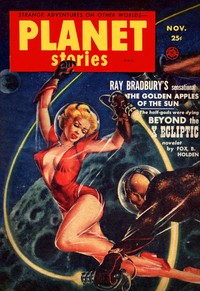
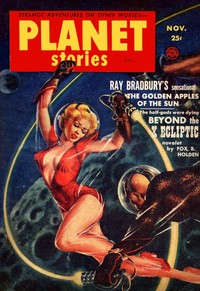
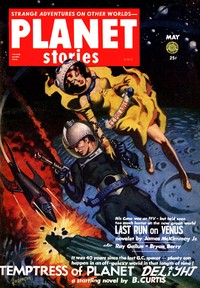
In a 1953 Planet Stories novella, pilot Nicholas Caine's final sightseeing run over Venus is disrupted by a reckless tourist and his companion, leading to a tense confrontation in forbidden territory that tests Caine's patience and principles.
Editorial Edition Score
4.5/5
★★★★★
★★★★★
Calculated from edition completeness, EPUB availability, text structure and catalogue metadata. Not a user rating.
Edition quality
The story opens with Nicholas Caine, a veteran pilot, on what he intends to be his last flight over Venus. The narrative immediately establishes his unease: the jetcopter feels sluggish, and his nerves are frayed. Caine's internal conflict is set against the backdrop of a Venusian jungle, where he is transporting two tourists—a girl with brown hair and a white teeth, and a thin, twitching boy who calls him "Driver." The boy's manic behavior and the girl's teasing presence grate on Caine, who has grown disillusioned with the colonists who have "ruined every chance for a decent relationship" with the planet. The opening efficiently conveys Caine's weariness and the tension that will drive the plot.
Caine's Last Run and the Weight of Experience
The narrative is anchored by Caine's perspective, a man who has seen the frontier of Venus transform from a rugged colony into a playground for the wealthy. His internal monologue reveals a deep-seated resentment: "the stupid, blind, selfish people who had ruined every chance for a decent relationship." This bitterness is not abstract; it is triggered by the specific behavior of his passengers. The boy's reckless enthusiasm and the girl's flirtatiousness are not just annoyances but symbols of a broader cultural shift that Caine rejects. The story's tension arises from the clash between Caine's hard-won experience and the tourists' oblivious entitlement. The reader is positioned to share Caine's irritation, but the excerpts also hint at his own complicity—he took the job, after all. This moral ambiguity is a key element of the work.
The Forbidden Plateau and the Venusians
The plot takes a sharp turn when the boy forces Caine to land on the Purple Plateau, a region sacred to the native Venusians. The description of the Venusians is brief but striking: "pale green skin and the globular heads and the large round eyes, lidless and soft-looking." They are presented as a peaceful, vulnerable people whose rights Caine has worked to protect. Now, he finds himself leading intruders into their sanctuary. The story thus introduces a colonial guilt theme, with Caine recognizing his role in bringing "the evil into the center of the Venusians' own private domain." The excerpts do not reveal the outcome of this encounter, but the setup suggests a moral reckoning. The Venusians are not monsters but victims, and Caine's responsibility for their safety becomes the central ethical dilemma.
The Boy's Unstable Violence and the Threat of Chaos
The boy's behavior escalates from annoying to dangerous. He wields a pistol erratically, screaming at Caine and striking the girl. The narrative emphasizes his unpredictability: "Fear had warped the already wayward brain, and to try to charge him or bully him or anything else would be like striking matches in a room full of explosives." This simile captures the volatility of the situation. The boy's actions are not those of a calculated villain but of a panicked, unstable individual. When he spots the Venusians, he opens fire indiscriminately, hitting Caine in the shoulder. The scene descends into chaos, with the boy "spinning and firing" until the gunfire abruptly stops. The excerpts cut off before the resolution, leaving the reader to wonder about the fate of the Venusians and the boy. The story's tension hinges on the boy's unpredictable violence, which threatens to destroy the fragile peace Caine has tried to maintain.
The excerpts present a tight, character-driven conflict set against a backdrop of colonial tension. Readers should pay attention to how Caine's internal struggle mirrors the external threat posed by the boy. The Venusians, though barely described, serve as a moral counterweight to the human characters' selfishness. The story's brevity—around 14,000 words—suggests a focused narrative that builds to a decisive confrontation. The ending is not provided here, but the setup promises a resolution that will test Caine's principles and his ability to act under pressure.
Reader reflection
Your personal reading reflection
Build a private reading journal entry for this title.
Your progress
0
/
10
2
What was your overall reaction to the book?
3
How likely are you to recommend this book?
4
How easy was the book to follow?
5
How personally connected did you feel to the book?
6
Did the book deliver what you hoped for?
7
How useful did the reading feel?
8
What was its emotional impact?
9
Which lesson or insight stayed with you?
10