
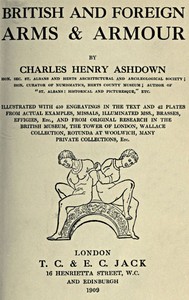
British and Foreign Arms & Armour by Charles Henry Ashdown
Let's be clear from the start: this isn't a novel. You won't find a dashing hero or a plot twist. Instead, think of it as a guided tour through a massive, imaginary armory, led by an enthusiastic expert from over a century ago.
The Story
There's no traditional narrative. The 'story' is the evolution of equipment. Ashdown starts way back with the weapons of early Britain and takes you on a chronological journey. He explains how a simple Norman shield changed shape over time to better protect a knight on horseback. He details the difference between a 'bastard sword' and a 'claymore.' He shows how armor progressed from chainmail to intricate plate, pointing out the clever engineering behind a helmet's visor or a gauntlet's joints. He doesn't just focus on England, either. The 'foreign' part of the title means you get comparisons to Italian, German, and Eastern European styles. The book is packed with line drawings—hundreds of them—showing every buckle, blade, and breastplate he describes. It's a systematic, almost loving, inventory of the art of personal combat.
Why You Should Read It
This is where it gets interesting. Reading Ashdown today is a double experience. First, you get a solid, well-researched primer on arms and armor. But second, you get a peek into the mind of a 1909 antiquarian. His writing has a palpable sense of preservation. He's not just listing facts; he's recording a heritage that he felt was slipping away. When he describes the weight of a lance or the technique for polishing a cuirass, there's a reverence for the craftsmanship. It makes you see these objects not just as tools, but as expressions of culture and technology. The black-and-white illustrations become more than diagrams; they feel like careful records of artifacts that might be lost. It turns a reference book into something quietly thoughtful.
Final Verdict
Perfect for history buffs, fantasy writers looking for authentic details, or anyone who's ever been mesmerized by a museum's armor hall. It's also a great pick for fans of 'slow' non-fiction—the kind of book you dip into for twenty minutes to learn about poleaxes. It's not for someone wanting a fast-paced military history or stories of famous battles. This is a book about the 'stuff' of war, written with a scholar's care and a collector's passion. If the idea of understanding the difference between a sallet and an armet helmet sounds cool to you, you'll find this old volume surprisingly engaging.
This book is widely considered to be in the public domain. You are welcome to share this with anyone.
Carol Hill
3 months agoAfter hearing about this author multiple times, the narrative structure is incredibly compelling. Highly recommended.
Noah Moore
1 year agoI came across this while browsing and the character development leaves a lasting impact. I couldn't put it down.





Amanda Nguyen
1 year agoTo be perfectly clear, the atmosphere created is totally immersive. I learned so much from this.