
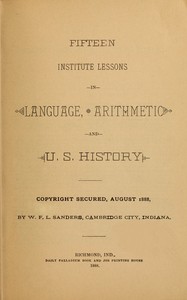
Fifteen Institute Lessons in Language, Arithmetic, and U.S. History by Sanders
Let's be clear from the start: this isn't a novel. 'Fifteen Institute Lessons' is a primary source, a snapshot of teacher training from the 1870s. Author William Sanders compiled these lessons to standardize instruction for teachers across the country, especially in the post-Civil War South. The book is divided into three sections, each containing five model lessons.
The Story
There's no plot, but there is a clear purpose. The book walks you through exactly how a teacher-in-training was supposed to conduct lessons in Grammar, Arithmetic, and U.S. History. The Grammar section focuses on parsing sentences and diagramming with military precision. Arithmetic drills down on mental math and practical problems like calculating interest. The History lessons are perhaps the most striking, offering a concise, curated narrative of America's founding and growth, clearly designed to instill a specific sense of patriotism and civic duty.
Why You Should Read It
The magic of this book isn't in thrilling prose; it's in reading between the lines. You see the priorities of the era: order, precision, and national unity. The history lessons are a masterclass in what a generation was told to remember—and by omission, what they were told to forget. The language lessons show a push toward a standardized American English. It’s a quiet book that makes you think loudly about how education shapes a society. I found myself constantly comparing these methods to today's classrooms.
Final Verdict
This book is a niche treasure. It's perfect for history buffs, educators, and anyone fascinated by how ideas are passed from one generation to the next. If you love narrative-driven stories, this isn't it. But if you've ever looked at the modern education debate and wondered, 'How did we get here?' this book provides some foundational answers. It's a short, sober, and surprisingly impactful look at the machinery of American learning during a critical point in the nation's history.
This text is dedicated to the public domain. It is now common property for all to enjoy.
Paul Hill
2 months agoBased on the summary, I decided to read it and the atmosphere created is totally immersive. Absolutely essential reading.
Liam White
6 months agoThis is one of those stories where the depth of research presented here is truly commendable. Thanks for sharing this review.
Sarah Hill
3 weeks agoI didn't expect much, but it creates a vivid world that you simply do not want to leave. Absolutely essential reading.


Amanda Walker
7 months agoAfter hearing about this author multiple times, the emotional weight of the story is balanced perfectly. Definitely a 5-star read.