1

A Soldier's Home Is Battle — Context and Discussion
(0 User reviews)
701
Project Gutenberg
2021
Not confirmed
Science fiction; Short stories; Soldiers -- Fiction; Nuclear warfare -- Fiction
Readers of public-domain and historical texts
Project Gutenberg digital edition
en
Edition facts
Words
5,995
Reading time
27 min
Text sections
1
Before opening A Soldier's Home Is Battle — Context and Discussion, the edition data offers a quick orientation: 5,995 words, 27 min estimated reading time, and 1 detected text section.
The text analysis averages about 14.7 words per sentence, while the detected sections provide another way to judge how the source is divided.
Project Gutenberg metadata also associates the work with “Science fiction,” connecting these edition facts with the source record’s subject description.
Source:
Project Gutenberg record #66282
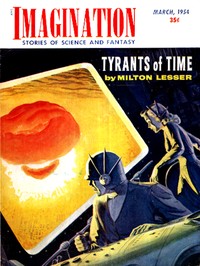
A 1954 science fiction story following Private First Class Jerry Conlon through a nuclear attack on his city, focusing on his sensory experience, duty, and the sudden reversal from defense to offense.
Editorial Edition Score
4.4/5
★★★★★
★★★★★
Calculated from edition completeness, EPUB availability, text structure and catalogue metadata. Not a user rating.
How this score is calculated
- Description quality20 pts
- Title & short description10 pts
- Source metadata20 pts
- Text length15 pts
- Chapters / structure15 pts
- EPUB file integrity20 pts
Total of 100 points, scaled to a 2.5-5.0 range. Editions with an empty description or a missing EPUB file are not scored.
Edition quality
Public-domain source text
Read the source text
The source text is kept in the dedicated reader, separate from this catalogue record and its commentary.
Lowell Stone's 1954 story opens with an atomic flash that 'faded out the sun,' immediately immersing the reader in a disoriented, ground-level perspective. Private First Class Jerry Conlon, stationed at an Atomic Gun Post on the city's perimeter, experiences the blast through fragmented senses: blinded eyes, a rising floor, and debris raining down for minutes. The narrative stays tightly bound to Jerry's physical and emotional reactions, moving from the concrete bunker to the exposed surface and back, tracing his wavering resolve.
Structure of Disorientation
The story's structure mirrors the chaos of its opening attack. Stone uses short, punchy sentences and abrupt transitions—'When he dropped to the concrete base, the floor rose to meet him halfway'—to convey the shock of the blast. The narrative jumps between Jerry's internal thoughts (his wife and son) and external events (the radar signal, the flash, the debris). This alternation creates a rhythm of panic and brief clarity, reflecting a soldier's struggle to process overwhelming sensory input. The later scene, where Jerry climbs out of the bunker to witness Army Comets, introduces a sudden tonal shift from despair to exhilaration, a structural pivot that underscores the story's exploration of duty and morale.
Recurring Images of Protection and Exposure
Stone repeatedly contrasts protected and exposed spaces. The Gun Post is 'holed into the ground and re-enforced with steel-mesh concrete,' yet the blast still lifts Jerry off the floor. Outside, the flat ground offers 'no protection' from shock waves. Jerry's radiation suit becomes a symbol of fragile safety—one soldier dies while struggling to zip his. The debris falling from the sky, 'mostly just the smaller pieces,' reinforces the idea that even the fortified post is vulnerable. Later, Jerry tosses his rifle over the bulwark, a gesture that abandons one form of protection (the weapon) for another (the group's mission).
Movement Between Levels
The story's spatial movement is deliberate: Jerry descends into the bunker, rises to the surface, and returns underground. After the flash, he 'dropped to the concrete base' and later 'crawled back to the protection of the bulwark.' When he decides to leave, he climbs out, but the sight of the Comets drives him back down: 'Jerry went down the steps holding his hands over his head.' This vertical motion—down for safety, up for action—mirrors his psychological wavering between fear and duty. The final ascent, when he shouts 'this war isn't over yet,' suggests a commitment to the fight, but the story ends before he fully re-enters the bunker, leaving his position ambiguous.
Voice and Sensory Detail
Stone's prose relies on concrete sensory details rather than exposition. The reader feels the 'suction' that raises Jerry, hears the 'roar' of the Comets, and sees the 'white blob' of Lieutenant Blake's face. Dialogue is sparse and functional—'Conlon, are you all right?'—but Jerry's internal monologue is vivid: 'The thought struck him with sickening force.' The story's voice shifts from clinical ('Private First Class Jerry Conlon glanced from the radar screen') to colloquial ('Hell, this war isn't over yet!'), grounding the speculative premise in a recognizable soldier's vernacular. This blend of technical jargon and raw emotion keeps the narrative immediate and personal.
Stone's story is best approached as a sensory snapshot rather than a plotted narrative. The excerpts suggest a tight focus on a single character's experience during and immediately after a nuclear strike, with the larger war remaining offstage. Readers should attend to the physical details—the feel of concrete, the sound of debris—and the way Jerry's perception of his mission shifts. The story's brevity (under 6,000 words) and its 1954 publication context invite consideration of Cold War anxieties, but the text itself offers no explicit political commentary.
I keep thinking about how Jerry Conlon’s world narrows to noise and dust, and then flips. There’s a strange ache in that—how duty holds you together until it doesn’t. It reminded me, quietly, of the balance in Maid—To Order — A Reader’s Guide, where routine masks a similar turning point. Both left a residual hum, like a room you’ve just left.
There are no reviews for this eBook.
There are no comments for this eBook.
Reader reflection
Your personal reading reflection
Build a private reading journal entry for this title.
Your progress
0
/
10
2
Was reading this book enjoyable?
3
Would you recommend this book to another reader?
4
Did the language feel accessible?
5
What was the strongest part of the book?
6
Could you see yourself revisiting this book?
7
Could you apply anything you learned?
8
How strong was your personal connection to the text?
9
What is the main idea you are taking away?
10