1

Werwile of the Crystal Crypt — Themes and Context
(0 User reviews)
71
Project Gutenberg
2021
Not confirmed
Science fiction; Adventure stories; Man-woman relationships -- Fiction; Archaeologists -- Fiction
Readers of public-domain and historical texts
Project Gutenberg digital edition
en
Edition facts
Words
12,673
Reading time
56 min
Text sections
2
For Werwile of the Crystal Crypt — Themes and Context, the stored edition analysis reports 12,673 words, 56 min estimated reading time, and 2 detected text sections.
The text analysis averages about 12.6 words per sentence, while the detected sections provide another way to judge how the source is divided.
Project Gutenberg metadata also associates the work with “Science fiction,” connecting these edition facts with the source record’s subject description.
Source:
Project Gutenberg record #64531
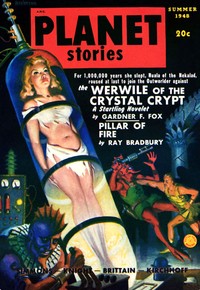
Clark Travis, a space-toughened archaeologist, navigates the ruins of Flormaseron and the city of Kovokod, seeking a sleeping goddess in a crystal crypt while evading the arklings and the scientist Rudra. The story moves from labyrinthine tunnels to bustling caravan roads and tower laboratories, with recurring images of darkness, red auras, and ancient carvings.
Editorial Edition Score
4.5/5
★★★★★
★★★★★
Calculated from edition completeness, EPUB availability, text structure and catalogue metadata. Not a user rating.
How this score is calculated
- Description quality20 pts
- Title & short description10 pts
- Source metadata20 pts
- Text length15 pts
- Chapters / structure15 pts
- EPUB file integrity20 pts
Total of 100 points, scaled to a 2.5-5.0 range. Editions with an empty description or a missing EPUB file are not scored.
Edition quality
Public-domain source text
Read the source text
The source text is kept in the dedicated reader, separate from this catalogue record and its commentary.
The story opens with Clark Travis fleeing through the black, labyrinthine tunnels of an ancient city on Flormaseron, a planet described as a "hellhole where Creation had run mad." His disintegrator sputters uselessly, and the arklings—creatures with a red aura—pursue him. Travis descends deeper into the ruins, past walls carved with odd animals and queerly human figures, into a darkness "as black as space itself." This initial movement establishes a pattern of descent and pursuit, with the protagonist relying on a beamlight against overwhelming darkness.
Descent and Discovery
The narrative repeatedly sends Travis downward into the bowels of the city, where he encounters bas-reliefs of "tall men and lovely women" from a vanished race. These carvings hint at a lost civilization, and the deeper he goes, the more he feels trapped in the arklings' domain. The tunnels are "dark strips out of Hades," and the only light comes from his beam or the arklings' red glow. This vertical movement—descending into the past—mirrors the story's central mystery: the sleeping goddess entombed in crystal.
Disguise and Movement Through Crowds
Later, Travis and Princess Nuala travel with a caravan, then enter the walled city of Kovokod. Travis feigns madness, babbling a Martian song, while Nuala uses a nobleman's ring to gain passage. The scene shifts from the claustrophobic tunnels to open roads, sleek horses, and pack-sloths. The city's "twin towers" are banded white and black, and the streets are raised lattices. This section contrasts the earlier darkness with daylight and crowds, yet the threat remains: Nuala warns that the towers are Rudra's laboratories, housing deadly weapons.
The Tower and the Door
At the tower, Travis confronts a door that is a "sheer rounded oval of stone" with no visible handle. Nuala explains it opens to vibratory impulses, and a blast of power would incinerate anyone who triggers it. Travis proposes a crude plan: walk toward it, then dart aside. This moment highlights his frustration—"stung" by Nuala's mockery, he insists that crudeness can work. The door becomes a symbol of the alien technology he must outwit, and his reliance on physical action contrasts with Nuala's ancient knowledge.
Recurring Images: Darkness, Light, and Ancient Carvings
Throughout the excerpts, darkness is a constant presence: the tunnels are "black as space," and Travis's beamlight is his only defense. The arklings' red aura provides an eerie counterpoint. The ancient carvings—"odd animals" and "queerly human things"—recur as reminders of the lost race. These images create a tactile sense of a world layered with history, where every descent reveals more of the past. The crystal crypt itself remains unseen, but the fragments of knowledge Nuala possesses hint at its power.
Readers should pay attention to how the story moves between enclosed spaces—tunnels, towers, and caravans—and how each setting imposes different constraints on Travis. The recurring motifs of light versus darkness and ancient versus modern technology are not merely decorative; they shape the protagonist's choices. The excerpts offer only partial views of the plot, but the structure of pursuit and disguise is clear from the opening pages.
Reading about Clark Travis picking through dark tunnels, I remembered sitting with my grandfather’s old dig journal, where he’d sketched carvings much like those. That same quiet awe surfaced later when I first opened Trouble on Sun-side — Edition Insights, and the red-tinged memory of a place I’d never seen felt almost familiar, like an echo waiting in the dust.
There are no reviews for this eBook.
There are no comments for this eBook.
Reader reflection
How did this book work for you?
Your answers remain private and are stored only in this browser.
Your progress
0
/
10
2
How did the book work for you overall?
3
Would you recommend this book to another reader?
4
What was the reading difficulty like?
5
Did it raise ideas you would like to talk about?
6
Did the book offer a fresh perspective?
7
Do you expect to return to this book?
8
Which part made the strongest impression?
9
Which lesson or insight stayed with you?
10