1

No time for Toffee! — Story, Setting & Ideas
15
2
Project Gutenberg
2021
Science fiction; Fantasy fiction; Subconsciousness -- Fiction
Readers of public-domain and historical texts
Project Gutenberg digital edition
en
Edition facts
Words: 31,055
Reading time: 136 min
Text sections: 4
Source:
Project Gutenberg record #65931
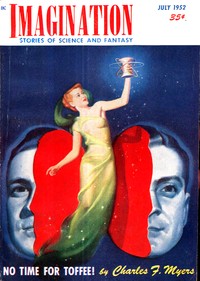
A man is shot dead at a microphone, only to find his consciousness summoned before a council of giant-headed beings in Limbo. They send him back to Earth as a ghost, where he must navigate a world of gangsters, a dangerously cheerful woman named Toffee, and his own naked, invisible existence.
Editorial Edition Score
4.6/5
★★★★★
★★★★★
Calculated from edition completeness, EPUB availability, text structure and catalogue metadata. Not a user rating.
Edition quality
The story opens with a jolt: Marc, a broadcaster, is shot mid-sentence in a control booth. The narrative then pivots to a surreal council in Limbo, where five beings with "preposterously large craniums" debate his fate. Their dialogue—marked by phrases like "blighted Pillsworth" and "phlegmy discontent"—establishes a tone of bureaucratic absurdity. The author, writing as Charles F. Myers, blends pulp violence with cosmic comedy, a pairing that defines the excerpts.
Diction and the Absurd Council
The High Council scenes showcase a deliberate clash between high-concept premise and mundane irritation. The Supreme Head "cleared his throat and Eternity rattled with phlegmy discontent," personifying cosmic forces with bodily functions. The Heads, having evolved into "literal representations of their titles," speak in a mix of bureaucratic formality and petty annoyance: "There's simply no keeping that man out of trouble." This diction undercuts the grandeur of Limbo, making the council feel like a celestial complaint department. The author uses this contrast to signal that the story will not take its own metaphysics too seriously.
Toffee's Dialogue as a Character Marker
Toffee, the eponymous character, speaks in a relentlessly cheerful register that unnerves those around her. Told she might die in a car accident, she replies, "I've always wanted to learn to drive," and later pats a thug's hand saying, "Just consider you're doing a public service." Her lines are consistently sunny, even when discussing her own demise. This verbal tic—a refusal to acknowledge danger—defines her more than any description. The gunman's reaction, "Too bad a good looking dame like you has to be so wacky," confirms that her dialogue is meant to be disorienting, not merely quirky.
The Naked-Man Argument: Structure and Repartee
Marc, now a ghost, commandeers a car driven by a woman he calls a "faded blonde." Their exchange escalates through a series of logical loops. She screams; he asks her to stop. She retorts, "When naked men come leaping into a lady's car... it gives her a great satisfaction to scream." Marc parries with, "Naked men don't leap into my car." The argument spirals into accusations about her inviting "a whole procession of naked men." This passage demonstrates the author's ear for comic bickering: each line builds on the previous misunderstanding, and the woman's indignation is punctured by Marc's deadpan literalism. The scene is structurally a set piece, showcasing how dialogue can drive both humor and character friction.
Voice and the Unreliable Ghost
Marc's narration, even in third person, carries a tone of beleaguered rationality. He prays for a police car, then jumps at the sound of an engine. His internal commentary—"Time was seeping out"—contrasts with the woman's shrill panic. Yet his own situation is absurd: he is a naked, invisible ghost. The author never lets Marc acknowledge this irony directly, instead letting his fussy reactions speak for themselves. This gap between Marc's earnestness and his ridiculous predicament is a consistent source of tension. The excerpts suggest a protagonist who is perpetually out of his depth, a quality reinforced by his inability to control any conversation he enters.
Readers should pay attention to how the author uses dialogue to reveal character rather than plot. The council's complaints, Toffee's relentless optimism, and the blonde's escalating arguments all serve to define personalities through speech patterns. The story's humor depends on these verbal clashes, not on the mechanics of ghostly existence. Treat the Limbo scenes as a framing device for a comedy of manners, albeit one with gangsters and gunfire.
Reader reflection
How will you remember this book?
Save your reaction, strongest insight, and memorable passage.
Your progress
0
/
10
2
Did this book hold your interest?
3
Would you recommend this book to another reader?
4
How demanding did the text feel?
5
How strong was your personal connection to the text?
6
Did the book meet your expectations?
7
How did the pace of the book feel?
8
How valuable was this book for your own interests?
9
In one sentence, what did you learn?
10