1

Failure on Titan — Reading Notes
14
2
Project Gutenberg
2021
Science fiction; Enslaved persons -- Fiction; Psychic ability -- Fiction; Phoebe (Satellite) -- Fiction
Readers of public-domain and historical texts
Project Gutenberg digital edition
en
Edition facts
Words: 10,762
Reading time: 47 min
Text sections: 2
Source:
Project Gutenberg record #64358
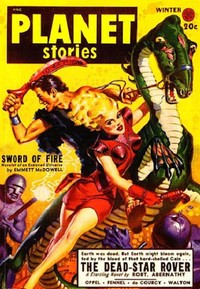
In Robert Abernathy's 1947 novella, a telepathic slave race called Woollies on Saturn's moon Phoebe becomes the tool of a power-mad human. The opening's vivid sensory detail—red eyes, nictitating membranes, and mind-probing—establishes a tense dynamic that the later excerpts escalate into a conspiracy of control and panic.
Editorial Edition Score
4.5/5
★★★★★
★★★★★
Calculated from edition completeness, EPUB availability, text structure and catalogue metadata. Not a user rating.
Edition quality
The story opens on Phoebe, a moon of Saturn, with a work gang of “Woollies”—hulking, white-haired beings who are a perfect slave race—moving in eerie unison. Their red eyes and nictitating membranes suggest non-human biology, but their minds are what set them apart: they perceive human personalities as “things as obvious as are apples or oranges.” The narrator immediately enters the consciousness of Big Bill, a Woolly, who senses hidden hatred in the minds of two human overseers and a sublime, godlike Plan in the third, Paul Gedner. This triple perspective—the slave’s alien senses, the humans’ concealed emotions, and Gedner’s cosmic ambition—is established in the first page and drives the entire novella.
The Woolly Mind as Narrative Lens
Abernathy uses Big Bill’s telepathic perception not as a gimmick but as the primary filter for the story’s tension. In the opening, the Woolly’s mind “touched” the humans’ and felt “an odd apathy behind which something tense and secret smoldered like a fire banked under ashes.” This is not mere description; it is a structural choice. The reader learns about Paige’s and Doc’s hatred before any action occurs, creating dramatic irony. Later, when Gedner speaks of controlling Big Bill so that “he thinks only what I think, he wants only what I want,” the earlier mind-probing gains a sinister weight. The Woollies are not just slaves; they are living lie detectors, and their obedience is both a weapon and a vulnerability.
Gedner’s Plan: From God Complex to Pirate Scheme
Paul Gedner is introduced as a figure “clothed in a tangible aura of power,” a “sublime and terrible god” to the Woollies. In the middle excerpt, his dialogue reveals a concrete plan: to commandeer the spaceship Zodiac and use the Woollies’ full potential to seize control of the Company and the Colonial Government. He explains to Leila that he has “made some discoveries” about controlling Woollies that no one else has realized. The plan is not mere piracy; it is a calculated scheme to exploit the panic caused by a single Woolly killing a man—an event he orchestrated. Abernathy grounds Gedner’s megalomania in specific, step-by-step plotting, making his madness feel methodical rather than abstract.
Leila as the Skeptical Counterweight
Leila’s arrival introduces a voice of reason and resistance. She immediately identifies Gedner’s power-crazed nature, calling him “crazy a lot. Power-crazy.” Her dialogue is sharp and confrontational: “Where will your little kingdom be then?” she asks, pointing out the impending Company investigation. Yet Gedner’s calm confidence unsettles her; she sees in him “the author of the fear and menace that had spread out from this remote moon.” Abernathy uses Leila to articulate the stakes for the reader—the collapse of the Saturnian Subsystem—while also showing her vulnerability. Her refusal to drink the tea and her frozen politeness hint at a deeper danger, making her more than a mere expository device.
The Weight of a Single Word: ‘Failure’
The title Failure on Titan promises that Gedner’s scheme will not succeed, but the excerpts leave the outcome ambiguous. The word “failure” resonates through the text in subtle ways. Big Bill’s opening action—shambling away from a “bloody, suddenly silent master”—is the first failure of control. Later, Gedner boasts that he has “got it, now,” but his plan relies on the Woollies’ obedience, which the opening has already shown to be imperfect. The story’s setting on Phoebe, a small moon, and the looming arrival of the Zodiac create a ticking clock. Readers should watch for moments where the Woollies’ perceptions diverge from Gedner’s commands, as these may be the cracks that lead to the titular failure.
Robert Abernathy’s novella is a tight, character-driven science fiction thriller that uses its alien slave race as both a plot device and a moral lens. The excerpts reveal a story built on layered tensions: between human and Woolly, between Gedner’s grand plan and the fragile obedience of his tools, and between Leila’s skepticism and the reader’s uncertainty. First-time readers will benefit from paying close attention to Big Bill’s sensory descriptions—they often carry clues that the human characters miss. The title is a promise; the pleasure lies in watching how it unfolds.
Reader reflection
What did you think of this book?
Answer a few questions and save a private reflection on this device.
Your progress
0
/
10
2
Did this book hold your interest?
3
Is this a title you would suggest to others?
4
How much effort did this book require?
5
Was the book moving at the right speed?
6
What was its emotional impact?
7
Did any part of the book feel personally relevant?
8
How distinctive were its ideas or approach?
9
What changed or sharpened your thinking?
10