1

The Ultimate Image — Key Ideas to Explore
14
3
Project Gutenberg
2021
Science fiction; Short stories; Maryland -- Fiction; Journalists -- Fiction; Weapons -- Fiction; Physicists -- Fiction
Readers of public-domain and historical texts
Project Gutenberg digital edition
en
Edition facts
Words: 10,223
Reading time: 45 min
Text sections: 1
Source:
Project Gutenberg record #64795
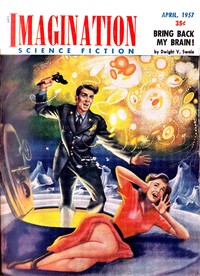
A journalist recounts a physicist's invention of a weapon that bends space, leading to a tense standoff with foreign agents in a Maryland mansion. The story moves from a garden scuffle to a basement laboratory, using recurring reflections and distorted images to blur reality.
Editorial Edition Score
4.4/5
★★★★★
★★★★★
Calculated from edition completeness, EPUB availability, text structure and catalogue metadata. Not a user rating.
Edition quality
The story opens not in a laboratory but in a garden, with the narrator vaulting a balustrade to join a scuffle. Bill Porter, a two-hundred-pound journalist, has tackled a smaller man and recovered a strange gun—a solenoid weapon firing steel darts. The setting shifts quickly from moonlit shrubbery to a reception hall crowded with Washington dignitaries, then descends into a hidden basement where physicist Dampier has built a device that warps space. This layered movement, from outdoor struggle to indoor politics to secret science, establishes a pattern of escalating confinement and revelation.
Recurring Reflections and Distorted Sight
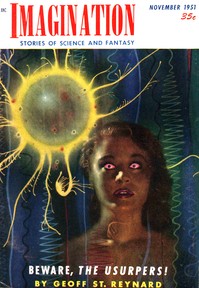
The narrative repeatedly uses reflective surfaces and distorted vision to unsettle the reader. Early on, the narrator spots the fallen gun by its glint in a patch of light. Later, Dampier’s machine appears as a “shining sphere” that swells like an inflating balloon, its surface showing “tiny distorted replicas of ourselves.” The characters see themselves doubled, peering into “unfathomable depths” where a twisted other room mirrors their own. Even the villain Nebel is first seen reflected in the sphere before the narrator turns to face him. These moments of indirect sight—glimpses caught in metal, light, or the machine itself—suggest that perception is unreliable and that the ultimate image may be a trap.
Movement Between Confined Spaces
The action progresses through a series of enclosed areas, each more restricted than the last. It begins in an open garden, then moves to a crowded reception hall, then down a stair to a hidden basement laboratory. Within that lab, the characters are pressed against a wall by armed intruders, and finally the sphere itself becomes a kind of prison of distorted space. The narrator’s physical journey mirrors a narrowing of options: from vaulting freely over a balustrade to being searched and forced back, unable to resist. The house, described as a “Gibraltar,” is breached from within, and the final confrontation occurs in the smallest, most controlled space—the room containing the machine.
The Scientist as Trapped Beast
Dampier, the physicist who built the weapon, is portrayed less as a mastermind and more as a cornered animal. When the three gunmen appear, his “white teeth gnawing like a rat’s at his black beard” and the “madness of a trapped beast” in his eyes. He responds to Nebel’s bow with “his fine tradition of insolence,” but his actions are reactive, not commanding. The narrator notes that Dampier’s fingers dart among the dials “tugging and twisting,” suggesting desperation rather than control. This characterization undercuts the typical mad-scientist trope: Dampier is not a cold genius but a man whose invention has outpaced his ability to manage the consequences, and whose ultimate weapon may be as much a threat to himself as to others.
Villainy Undercut by Mundane Detail
Ambassador Nebel is introduced as a satanic figure—“Satan at the sacrifice!”—but the narrative immediately deflates this image. He puts on “thick, steel-rimmed spectacles,” his shoulders slouch, and his trousers draw tight as he bends to examine the sphere. The narrator reinterprets him as a “Teuton peddler, stooping to finger the weave of some shoddy cloth.” This shift from melodramatic villainy to petty, physical detail is characteristic of the story’s style: grand threats are undercut by concrete, unflattering observations. Nebel’s crimson ribbon is compared to a “line of blood,” yet his heavy breathing and creaking breeches make him seem absurd rather than terrifying. The effect is to keep the reader uncertain whether the danger is real or theatrical.
Readers should pay attention to how the story uses light and reflection to create uncertainty about what is real. The narrator’s perspective is limited—he is a journalist, not a scientist—so the machine’s true nature remains partly obscured. The movement from open air to underground room is not just plot mechanics but a deliberate tightening of the narrative’s focus. The ultimate image may be the sphere itself, or the distorted reflections it casts, but the story leaves that question open.
Reader reflection
Before you leave, reflect on the book
Use these questions to collect your thoughts before moving on.
Your progress
0
/
10
2
Did this book hold your interest?
3
Would you pass this book on to a friend?
4
What was the reading difficulty like?
5
What did you think about the pace?
6
Did the book deliver what you hoped for?
7
Did this book create an emotional response?
8
Did you gain anything practical from the text?
9
What is the main idea you are taking away?
10