1

Secret of the Painting — A Closer Reading
15
2
Project Gutenberg
2021
Science fiction; Adventure stories; Inventors -- Fiction
Readers of public-domain and historical texts
Project Gutenberg digital edition
en
Edition facts
Words: 9,625
Reading time: 42 min
Text sections: 1
Source:
Project Gutenberg record #65533
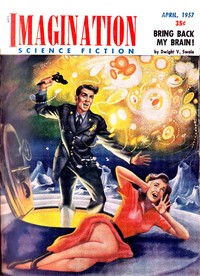
In this 1957 science fiction novella, inventor Tom Calhoun races to perfect a device that transfers energy to heal his dying assistant Ann. Narrated by his friend Luke Shaw, the story blends hard-boiled dialogue with speculative physics, as a mysterious painting holds the key to a revolutionary discovery.
Editorial Edition Score
4.4/5
★★★★★
★★★★★
Calculated from edition completeness, EPUB availability, text structure and catalogue metadata. Not a user rating.
Edition quality
The story opens with a barroom confrontation that sets the tone for the entire novella. Luke Shaw, the narrator and bodyguard for inventor Tom Calhoun, is approached by a man with a whining voice and a bulge under his arm. The man wants to know if Luke works for Calhoun. Luke’s internal commentary—noting the man’s jaw as “a perfect target for a left jab”—establishes a hard-boiled, first-person voice that carries through the narrative. This is not a detached scientific report but a personal account from a man whose job is to protect his friend from curiosity seekers and potential threats.
A Narrator Who Watches and Judges
The excerpts reveal that Luke Shaw is not a passive observer. He reads people’s appearances and motives with a cynical eye: the stranger’s expensive but unpressed clothes, the way he wears them, the hidden gun. Luke’s loyalty to Tom Calhoun is absolute, but his narration is laced with dry humor and physical assessment. He measures the man for a gun, notes the grudging respect when no weapon is found, and reflects that “commies” never look like what they are. This voice—tough, wary, and protective—gives the story a noir texture that contrasts with the science-fictional premise.
The Race Against Time in a Hospital Room
The most extended excerpt places the reader in a hospital room where Ann Briscoe is dying. Tom Calhoun brings a breadboard instrument with a cone that emits a white radiation. Dr. Crane is skeptical but desperate. Tom explains that the visible light is a flaw—the generator is not working properly. The scene is tense: sweat on faces, a nurse’s footsteps in the corridor, a car horn in the distance. Tom’s voice shifts to that of a professor lecturing on energy and matter, but the urgency remains. The doctor cuts bandages to find new flesh and new skin, a moment that astonishes him. The excerpt ends with Tom’s philosophical turn: “energy is all that exists,” and beyond that, “mind.”
Energy, Matter, and the Unseen Component
Tom Calhoun’s explanation to Dr. Crane is the story’s conceptual core. He describes energy in motion as light, slowed energy as matter, and the human body as “an infinite number of dancing points of light.” But he posits something else: mind, which works with energy, directs it, and moulds it. The doctor’s reaction—a stutter, a glaze in his eyes—underscores the revolutionary nature of the claim. The excerpts do not reveal how the painting fits in, but the title and the catalog subject “Inventors -- Fiction” suggest that the painting is a key to this knowledge. The narrative thus weaves a hard-boiled frame with speculative physics, leaving the reader to discover the painting’s secret.
Readers should pay attention to the interplay between Luke’s streetwise narration and Tom’s theoretical monologues. The story’s brevity (under 10,000 words) means every scene carries weight. The painting itself is mentioned only in the title and the opening blurb; its role must be inferred from the context of Tom’s work and the threats surrounding him. The excerpts offer no resolution, only a setup that promises a convergence of art, science, and danger.
Reader reflection
What did you think of this book?
Answer a few questions and save a private reflection on this device.
Your progress
0
/
10
2
Did this book hold your interest?
3
Would you encourage someone else to read it?
4
What was the reading difficulty like?
5
What did you appreciate most?
6
How would you rate its originality?
7
Was the book easy to understand?
8
Would you like to discuss this book with someone?
9
What is the main idea you are taking away?
10