1

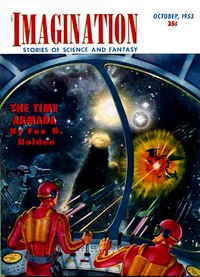
The Time Armada — Background and Themes
16
2
Project Gutenberg
2021
Science fiction; Adventure stories; Inventions -- Fiction; Families -- Fiction
Readers of public-domain and historical texts
Project Gutenberg digital edition
en
Edition facts
Words: 52,542
Reading time: 229 min
Text sections: 6
Source:
Project Gutenberg record #65072
Congressman Doug Blair, a former physicist, navigates political corruption and a mysterious invention in his basement, while his wife Dot receives a threatening phone call from a seemingly innocuous culture society, leading to her abduction by men in white uniforms and a journey to Venus.
Editorial Edition Score
4.7/5
★★★★★
★★★★★
Calculated from edition completeness, EPUB availability, text structure and catalogue metadata. Not a user rating.
Edition quality
The story opens with Congressman Douglas Blair, a former physicist, shivering in a gray Washington drizzle, his head aching and his mood sour after a contentious day over the McKenny bill. The bill's sponsor, McKenny, openly declares that "the people never had anything to say about it" and that government is for professionals—a sentiment that leaves Blair disheartened. In the car with his friend Carl, Blair vents about political dishonesty, wishing for "windshield wipers for the brain" to clear his thoughts. This blend of political cynicism and scientific metaphor sets the tone for a narrative that intertwines domestic unease with speculative technology.
Political Disillusionment and Scientific Metaphor
The opening pages establish Blair as a weary idealist trapped in a corrupt political system. His conversation with Carl reveals a deep frustration with McKenny's brazen dismissal of public input. Blair's wish for "windshield wipers for the brain" is a striking image that bridges his scientific background and his mental fatigue. The dialogue is laced with colloquialisms—"Republicans got your tongue?"—and a sense of helplessness. Blair's reflection that "the way of living we've got in this country isn't so bad but what just plain honesty and a little intelligence couldn't run it right side up" underscores a central tension: the gap between democratic ideals and political reality. This is not a generic political thriller; the specific bill and McKenny's characterization give the conflict a concrete, period-appropriate edge.
Domestic Unease and the Threat of the Ordinary
Blair's wife Dot receives a phone call from a woman claiming to be from a culture society. The conversation is brief but unsettling: the caller's tone shifts from polite to menacing, and Dot senses "something missing" in the woman's voice. After hanging up, Dot feels the room grow cold and dismisses her fear as "nerves," recalling a previous false alarm. Yet the tension escalates when four men in white uniforms appear at her door, stating they have "linked" her with the society. The men's precise, impersonal language—"You received a telecall several minutes ago, did you not, Madame?"—contrasts sharply with Dot's flustered denials. The scene transforms a mundane domestic setting into a site of coercion, hinting at a surveillance state that operates through seemingly benign organizations.
Transition to Space: The Inversion and Venus
Chapter XIII shifts abruptly to a spacecraft approaching Venus. The narrative voice becomes technical, describing the "inversion" maneuver and the artificial gravity system based on gyroscopes. The journey is monotonous: "Space had been monotonous" after the initial thrill, and the view of Earth shrinking is followed by a "pea-soup fog" on Venus. Blair's panic—"little pangs of panic, of fear"—is understated but palpable. The chapter's clinical language, with phrases like "Inside Venus compensation limit" and "Secondary check please, sergeant," contrasts with the earlier emotional turmoil on Earth. This section suggests that the story's scope expands from political intrigue to interplanetary action, though the excerpts leave the connection between Blair's political struggles, Dot's abduction, and the Venus mission unclear.
The excerpts present a story that moves from a recognizable political landscape to a speculative one involving time travel (as the title suggests) and interplanetary conflict. Readers should note the careful construction of atmosphere—the drizzle, the cold chair, the syrupy whiteness of Venus—and the way ordinary objects (a phone call, a car ride) become charged with threat. The incomplete narrative leaves many questions: How does Blair's past as a physicist connect to the invention in his basement? What is the nature of the culture society? The fragments reward attention to small details and shifts in tone.
Reader reflection
Before you leave, reflect on the book
Use these questions to collect your thoughts before moving on.
Your progress
0
/
10
2
How did the book work for you overall?
3
Would you pass this book on to a friend?
4
How easy was the book to follow?
5
How strongly did the book affect you emotionally?
6
Could you follow the author’s main argument?
7
How useful were the ideas in this book?
8
How personally connected did you feel to the book?
9
What changed or sharpened your thinking?
10