1

Open Invitation — Text and Context
15
2
Project Gutenberg
2020
Science fiction; Short stories; Extraterrestrial beings -- Fiction; Human-alien encounters -- Fiction
Readers of public-domain and historical texts
Project Gutenberg digital edition
en
Edition facts
Words: 6,406
Reading time: 28 min
Text sections: 1
Source:
Project Gutenberg record #64071
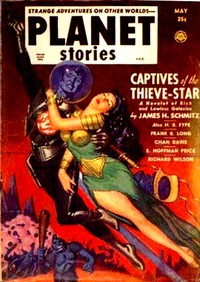
In H. B. Fyfe's 1951 short story, Yaradirian bureaucrats debate the threat of Earthlings discovering their home star, using dry humor and alien physiology to explore miscommunication and escalating dread.
Editorial Edition Score
4.4/5
★★★★★
★★★★★
Calculated from edition completeness, EPUB availability, text structure and catalogue metadata. Not a user rating.
Edition quality
H. B. Fyfe's "Open Invitation" opens not with a human perspective but with the bureaucratic frustrations of an alien named Ullo Dah-Gow, whose walking tentacles stick to a dry floor on the planet Yaradir. The story immediately establishes a non-human sensory world: moisture is essential, cursing involves "Fire and dry sand!" and status is measured by access to mud tubs. This physical grounding in alien biology sets the tone for a narrative that treats its extraterrestrial viewpoint seriously, even as it satirizes office politics and red tape.
Alien Physiology as Worldbuilding
Fyfe builds his alien society through constant reference to moisture, scales, and tentacles. Characters lubricate their scales, oil their hides, and complain about dry footing. The Yaradirians are amphibious beings whose comfort and survival depend on humidity—a detail that makes their fear of Earth, a planet with abundant water, ironically layered. The narrative voice adopts their perspective without apology: "two of his four walking tentacles stuck slightly on a nearly dry spot" is the story's first sentence, immediately immersing the reader in a non-human sensorium. This physicality extends to dialogue, where insults like "Dessication!" carry literal weight. The aliens' biology is not mere decoration; it drives their behavior, from the need for mud tubs in meetings to the panic over a scout who has been "roughing it" with only a minimum film of moisture.
Bureaucratic Comedy and Dread
The story's central conflict unfolds through office banter and chain-of-command squabbles. Ullo resents his superior's nepotism; Ahnu Nol-Yev is more concerned with delays and expense than with the potential catastrophe of Earthmen learning their star's location. The dialogue is peppered with dry humor: "How could we be so dry inside the skull?" laments Ullo after a missed implication. Yet beneath the comedy, a genuine threat emerges. The scout Zoya Lar-Tul has been stranded, his base destroyed, and the Yaradirians realize they may have inadvertently sent Earth an invitation. The shift from petty irritation to existential dread is handled through understatement—Ullo's shudder, his application for transfer "in the opposite direction from this Sol." The final lines, with their trailing ellipsis, leave the reader with an unfinished sentence that mirrors the open-ended horror.
Pacing and the Unseen Threat
Fyfe controls pace by alternating between mundane office scenes and sudden leaps in time. The story compresses weeks or years into single paragraphs: "two yaras later," "after one yara at the new post." These jumps create a sense of inexorable movement, as Ullo flees farther and farther but never escapes. The Earthmen themselves remain offstage—their only presence is through reports and the aftermath of an explosion. This absence heightens tension; the reader knows only what the Yaradirians know, and their knowledge is fragmentary. The final line, "But not ... far ... enough...." is a masterclass in economy, suggesting a pursuit that has finally caught up. The story ends not with a confrontation but with a trailing-off, leaving the scale of the disaster to the imagination.
Readers should pay attention to how Fyfe uses the aliens' own terminology and sensory details to create a world that feels lived-in, not just a backdrop for human concerns. The story rewards attention to small physical cues—a dry spot, a missing oiling—that carry emotional weight. The ending, abrupt and ambiguous, invites speculation about what happens next, but the text itself provides no answers. This restraint is the story's strength.
Reader reflection
Before you leave, reflect on the book
Use these questions to collect your thoughts before moving on.
Your progress
0
/
10
2
Did this book hold your interest?
3
Would you recommend this book to another reader?
4
What was the reading difficulty like?
5
How did the pace of the book feel?
6
Could you follow the author’s main argument?
7
How closely did the book connect with your experience?
8
What was the strongest part of the book?
9
In one sentence, what did you learn?
10