1

Sword of the Seven Suns — Edition Insights
13
2
Project Gutenberg
2021
Science fiction; Adventure stories; Life on other planets -- Fiction
Readers of public-domain and historical texts
Project Gutenberg digital edition
en
Edition facts
Words: 20,162
Reading time: 88 min
Text sections: 2
Source:
Project Gutenberg record #64364
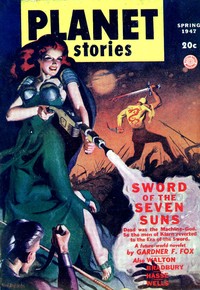
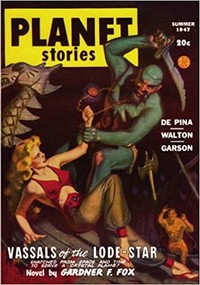
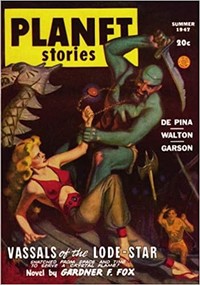
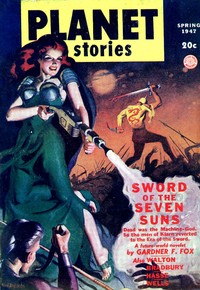
In Gardner F. Fox's 1947 space adventure, a crashed Earth ship strands colonists on a planet orbiting Deneb, where a dead Machine-God and a sword with seven stars set the stage for a struggle between hope and despair.
Editorial Edition Score
4.6/5
★★★★★
★★★★★
Calculated from edition completeness, EPUB availability, text structure and catalogue metadata. Not a user rating.
Edition quality
The opening pages of Sword of the Seven Suns drop the reader into a spaceship hurtling toward a planet of Deneb, with forward jets shot and no time to fix them. The captain's wife whispers, 'At least we'll go together, darling,' and the ship crashes. This is not a tale of sleek starfleets but of a desperate colony trying to survive on a world where their Machine-God has died and savage hordes threaten to overrun them.
Fox builds tension through contrasts: the captain's dream of 'a land to bring the restless spirits' versus the grim reality of a planet under siege. The narrative voice shifts between the captain's scientific ambition and the raw survival instinct of later characters like Flane, who laughs and jests even as a pall hangs over his companions. The sword with seven stars becomes a tangible symbol of hope, but its power remains ambiguous.
A World of Contrasts: Light and Shadow
The planet Klarn is defined by stark oppositions. The Darksiders, named for their shadowy threat, are described as 'a swollen shadow along the ground,' while Flane's group rides a magniship that floats above the plains. The landscape itself shifts from 'rolling plains covered with long grasses' to 'high, black mountains that cupped mounds of snow.'
Fox uses sensory details to heighten the contrast: the 'howl of a wolf on sighting its prey' from the Darksider horde versus the 'moonlight' that makes the sword glimmer. The Darksiders carry 'kaatra-tail banners' and ride 'war-megathons,' while Flane's people rely on a 'violet-gun' and the hope of finding a key to the Machine. This visual and tonal dichotomy reinforces the central conflict between brute force and fragile technology.
The excerpts do not reveal whether the Machine-God can be revived or if the key exists, but the pattern of light versus shadow—both literal and metaphorical—suggests a world where survival depends on navigating these extremes.
Flane's Defiance and the Weight of Despair
Flane stands apart from his companions. While others are 'morosely' staring at their plates, he 'still laughed and jested.' His philosophy is blunt: 'Not knowing, but doing and fighting every inch of the pathway through life—that's what counts!' This attitude is tested when he faces the Darksider horde. Dangled over the side of the magniship, he offers peace terms, but the Darksider roars back about 'wetted my blades in his flesh.'
Fox contrasts Flane's bravado with the despair around him. Aevlyn wishes she were of his race, saying, 'You never admit defeat, even if you have already failed!' Flane's response—'We take a different path, that's all'—reveals a stubborn optimism that may be naive or heroic. The sword with seven stars is his talisman: 'When you hold it, you can't fail!' Yet the narrative undercuts this certainty by showing the overwhelming odds and the missing key to the Machine.
The excerpts leave unclear whether Flane's confidence is justified or if it will lead to disaster. His character embodies the tension between action and futility that runs through the story.
Technology and the Absent God
The 'Machine-God' is a central but absent presence. It is dead, and its key is lost. The Darksiders seem to have no interest in it, while Flane's people seek it as their only hope. The spaceship itself is a relic of Earth technology, now crashed and useless. The captain's calculations proved the planets habitable, but that knowledge did not prevent the crash.
Fox presents technology as both a lifeline and a failure. The 'violet-gun' is a weapon, but Flane doubts it can stop the horde. The magniship is a means of transport, but it cannot raise an army. The Machine-God, if found, might grant power, but its nature is undefined. The sword, though ancient, is a hand-to-hand weapon in a world of catapults and mangonels.
This tension between advanced science and primitive necessity creates a unique texture. The colonists are stranded six hundred light-years from Earth, yet they fight with spears and arrows. The excerpts do not explain why the Machine died or what it did, but the search for its key drives the plot forward.
Readers should pay attention to how Fox balances the epic scale of interstellar travel with the intimate struggles of individual characters. The sword's seven stars are mentioned but not explained; their significance may unfold as the story progresses. The Darksiders are portrayed as a monolithic threat, but their motives remain unexplored in these excerpts. Approach the text as a product of its genre and era, where action and dialogue carry the weight of worldbuilding.
Reader reflection
How will you remember this book?
Save your reaction, strongest insight, and memorable passage.
Your progress
0
/
10
2
How much did you enjoy the reading experience?
3
Is this a title you would suggest to others?
4
How easy was the book to follow?
5
How clearly were the main ideas presented?
6
Was the book moving at the right speed?
7
How useful did the reading feel?
8
Was the book what you thought it would be?
9
What is the main idea you are taking away?
10