1

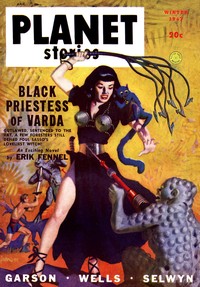
Black Priestess of Varda — A Reader’s Guide
(0 User reviews)
1635
Project Gutenberg
2021
Not confirmed
Science fiction; Adventure stories; Man-woman relationships -- Fiction; Life on other planets -- Fiction
Readers of public-domain and historical texts
Project Gutenberg digital edition
en
Edition facts
Words
32,223
Reading time
141 min
Text sections
3
Before opening Black Priestess of Varda — A Reader’s Guide, the edition data offers a quick orientation: 32,223 words, 2 hr 21 min estimated reading time, and 3 detected text sections.
The text analysis averages about 13.6 words per sentence, while the detected sections provide another way to judge how the source is divided.
Project Gutenberg metadata also associates the work with “Science fiction,” connecting these edition facts with the source record’s subject description.
Source:
Project Gutenberg record #64511
Erik Fennel's 1947 novel follows Eldon Carmichael, a disfigured Earth scientist transported to the planet Varda, where he is mistaken for a legendary savior. The excerpts reveal a protagonist grappling with physical and psychological trauma, a telepathic dream world, and a conflict between personal escape and cosmic responsibility.
Editorial Edition Score
4.6/5
★★★★★
★★★★★
Calculated from edition completeness, EPUB availability, text structure and catalogue metadata. Not a user rating.
How this score is calculated
- Description quality20 pts
- Title & short description10 pts
- Source metadata20 pts
- Text length15 pts
- Chapters / structure15 pts
- EPUB file integrity20 pts
Total of 100 points, scaled to a 2.5-5.0 range. Editions with an empty description or a missing EPUB file are not scored.
Edition quality
Public-domain source text
Read the source text
The source text is kept in the dedicated reader, separate from this catalogue record and its commentary.
The opening pages of Black Priestess of Varda introduce Eldon Carmichael not as a capable hero but as a man shattered by a workplace accident: he has lost an arm and an eye, his fiancée has returned his ring, and he drinks alone in his laboratory. The prose dwells on his physical limitations—the “stub of his left arm” that cannot hold paper steady, the pen that leaves “a long black streak and a blot”—and his spiraling self-pity. This is a protagonist defined by loss, not by the adventure that awaits him.
The catalog subjects list “man-woman relationships” and “life on other planets,” but the excerpts show that the central relationship is not romantic in any conventional sense. Eldon’s bond with Krasna, a native of Varda, unfolds in a shared telepathic dream-space where they communicate as “thought-bodies.” Their connection is built on mutual dependence and survival, not courtship.
A Crippled Protagonist in a Space-Adventure Frame
The catalog classifies this as science fiction and adventure, yet the excerpts spend considerable time on Eldon’s disability and psychological state. His injury is not a prelude to a miraculous cure but a persistent reality: he cannot write a letter, he sobs in frustration, and he drinks to numb his thoughts. Even after he regains his arm and eye in Varda’s Chamber, the narrative notes that the new limb is “less heavily muscled” and “looked newer,” as if his body remains a site of strangeness. The adventure plot—rescue missions, battles against Sasso—is present, but the text repeatedly returns to Eldon’s interior experience of inadequacy and longing for Earth.
The Dream World as Refuge and Trap
Eldon and Krasna create a private world through their linked minds, a place where he is “whole, not a cripple.” This setting is described in abstract terms: a “thought-world” with its own roads, a place that can be altered by will. The excerpts show that this refuge is fragile. When Krasna leaves, Eldon finds their shared world “dreary and dead without her,” and he fears that eternal solitude would drive him mad. The dream world is not a simple escape; it is a temporary solution that underscores his isolation. The text also hints at danger: if they stay too long, they risk being “lost here forever,” trapped in a limbo of their own making.
The Legend of Elvedon and Eldon’s Reluctance
The catalog subjects include “life on other planets” and “adventure stories,” but the excerpts focus on a specific narrative device: the prophecy of Elvedon, a savior figure. Krasna repeatedly identifies Eldon as Elvedon, but he rejects the label: “I am not El-ve-don.” His denial is not modesty but a genuine refusal of the role. He wants only to return to Earth, and he dismisses the threat of Sasso as something he cannot believe in. The text thus sets up a tension between the expectations of the adventure genre—a hero accepting a quest—and Eldon’s persistent desire to opt out. The excerpts do not reveal whether he ultimately embraces the role, leaving the resolution open.
The excerpts from Black Priestess of Varda offer a story that is as much about psychological damage and reluctant heroism as about interplanetary conflict. Readers should note how the text balances Eldon’s internal struggles with the demands of a pulp plot, and how the dream-world sequences complicate the usual space-opera tropes. The novel rewards attention to its protagonist’s vulnerabilities, which are not merely backstory but active elements of the narrative.
Fennel’s Carmichael carries his scars into a dream-world that feels more real than waking life, and I keep thinking about how that longing for escape echoes into The Sinister Invasion — Key Ideas to Explore — the way a quiet refuge can turn out to have its own shadow, its own price. The 1947 voice still hums here, faint but unmissable. The Sinister Invasion — Key Ideas to Explore rests on my shelf now, a strange neighbor to Carmichael’s long afternoons.
There are no reviews for this eBook.
There are no comments for this eBook.
Reader reflection
How did this book work for you?
Your answers remain private and are stored only in this browser.
Your progress
0
/
10
2
How did the book work for you overall?
3
Would you recommend this book to another reader?
4
How easy was the book to follow?
5
How strongly did the book affect you emotionally?
6
Was the book easy to understand?
7
How distinctive were its ideas or approach?
8
Do you expect to return to this book?
9
What is the main idea you are taking away?
10