1

The Sinister Invasion — Key Ideas to Explore
(0 User reviews)
1222
Project Gutenberg
2021
Not confirmed
Science fiction; Adventure stories; Spy stories; Human-alien encounters -- Fiction
Readers of public-domain and historical texts
Project Gutenberg digital edition
en
Edition facts
Words
24,992
Reading time
109 min
Text sections
3
For The Sinister Invasion — Key Ideas to Explore, the stored edition analysis reports 24,992 words, 1 hr 49 min estimated reading time, and 3 detected text sections.
The text analysis averages about 12.6 words per sentence, while the detected sections provide another way to judge how the source is divided.
Project Gutenberg metadata also associates the work with “Science fiction,” connecting these edition facts with the source record’s subject description.
Source:
Project Gutenberg record #65483
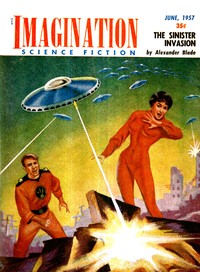
In this 1957 science fiction novella, electrical engineer Ross Birrel is recruited against his will for interstellar counter-espionage. The excerpts show a protagonist who resists, then is drawn into a conflict involving alien factions, space travel, and a mysterious enemy named Vannevan.
Editorial Edition Score
4.6/5
★★★★★
★★★★★
Calculated from edition completeness, EPUB availability, text structure and catalogue metadata. Not a user rating.
How this score is calculated
- Description quality20 pts
- Title & short description10 pts
- Source metadata20 pts
- Text length15 pts
- Chapters / structure15 pts
- EPUB file integrity20 pts
Total of 100 points, scaled to a 2.5-5.0 range. Editions with an empty description or a missing EPUB file are not scored.
Edition quality
Public-domain source text
Read the source text
The source text is kept in the dedicated reader, separate from this catalogue record and its commentary.
The story opens not with a cosmic vista but with a locked-room confrontation in a New York apartment. Ross Birrel, an electrical engineer and former OSS operative, finds a gray-suited stranger waiting for him. The intruder’s refusal to show credentials and his casual mention of Birrel’s bachelorhood and financial state establish a tone of bureaucratic menace. The physical struggle that follows—Birrel’s OSS-trained chop parried by the same move from the stranger—immediately signals that this is a world of trained professionals, not random violence. The gray man’s admission that he too was in the OSS adds a layer of mirrored competence. This opening efficiently blends domestic realism with the suggestion of a hidden apparatus operating within ordinary life.
Recruitment by Ambush
The gray man’s method of recruitment is coercive and secretive: he breaks into Birrel’s home, refuses to explain himself, and physically overpowers the protagonist. Birrel’s anger and suspicion are palpable—he calls the man crazy and tries to fight. The gray man’s line “We merely have a proposition to put to you” is undercut by the fact that Birrel is given no real choice. This pattern of forced cooperation recurs when Birrel later boards the alien ship: the hatch grinds shut “with relentless precision,” and he knows he is trapped. The story’s central dynamic—an ordinary man pressured into extraordinary service—is established through these parallel scenes of involuntary departure.
Alien Technology as Concealment
The excerpts present alien technology that hides rather than dazzles. The spaceship is invisible due to “light rays bent in a magnetic field,” requiring a special viewfinder to see. The interior smells “like a submarine, of oil and metal and canned air,” grounding the fantastic in the industrial. Kara’s casual explanation of the invisibility field and her adjustment of a “small gadget like a camera view-finder” treat advanced science as routine. This matter-of-factness contrasts with Birrel’s visceral terror during take-off: he feels “crushed into a flattened pulp” and yells in panic. The technology is not wondrous but functional and threatening, emphasizing the protagonist’s vulnerability.
Pursuit and the Named Enemy
Once in space, the narrative shifts from recruitment to chase. Thile’s ship is immediately pursued by another vessel that took off from Earth “right behind us.” The enemy is named: Vannevan, who is apparently watching radar for their departure. Kara’s fierce exclamation—“I knew he’d never let us get back to Ruun if he could help it!”—reveals a factional conflict among aliens (or humans allied with them) operating on Earth. The names Ruun and Vannevan are introduced without explanation, suggesting a larger political context that the excerpts only hint at. This pursuit structure, combined with the earlier OSS background, frames the story as a spy thriller in space, where the protagonist is a pawn in a conflict he does not yet understand.
The excerpts provide a strong sense of the story’s opening act: a reluctant hero, hidden technology, and a chase across space. Readers should note that the narrative voice remains close to Birrel’s perspective, filtering the alien through his engineer’s eye and his OSS-trained reflexes. The catalog subjects list “spy stories” alongside “human-alien encounters,” and the text bears this out more than a generic alien invasion tale might suggest. The fragments do not reveal the nature of Vannevan’s threat or the outcome of the chase, leaving the reader to discover how Birrel’s counter-spy role develops.
Reading about Ross Birrel’s reluctant pull into another world, I kept thinking of the quiet unease in Task of Kayin. Both feel like stories about being chosen, not for glory, but for a purpose that settles on your shoulders. There’s a particular loneliness in that. Task of Kayin — Context and Discussion captures a similar, almost wistful burden.
There are no reviews for this eBook.
There are no comments for this eBook.
Reader reflection
How will you remember this book?
Save your reaction, strongest insight, and memorable passage.
Your progress
0
/
10
2
Did this book hold your interest?
3
Would you encourage someone else to read it?
4
How easy was the book to follow?
5
What did you appreciate most?
6
How clear did the writing feel?
7
How strongly did the book affect you emotionally?
8
How original did the book feel?
9
What did this book teach you most?
10