1

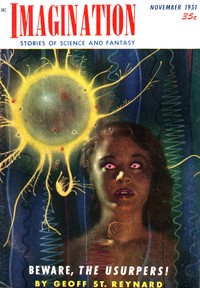
Beware, the Usurpers! — A Reader’s Guide
7
0
Project Gutenberg
2021
Science fiction; England -- Fiction; Human-alien encounters -- Fiction; Vision -- Fiction
Readers of public-domain and historical texts
Project Gutenberg digital edition
en
Edition facts
Words: 37,627
Reading time: 164 min
Text sections: 4
Source:
Project Gutenberg record #65437
In a crumbling English castle, a group of six people confronts an alien invasion where monsters inhabit human bodies. The narrator, Will, argues that killing the human host may also kill the alien, challenging earlier assumptions. Tension builds as they debate the nature of the usurpers and the morality of their mission.
Editorial Edition Score
4.6/5
★★★★★
★★★★★
Calculated from edition completeness, EPUB availability, text structure and catalogue metadata. Not a user rating.
Edition quality
The story opens with the narrator driving a black Jaguar to a decaying castle in the English countryside, where the atmosphere is thick with decay and menace. He finds a dead rook with its eyes pecked out, a detail that sets the tone for the unease to come. Inside, six people await him in a lit room, each described with precise physical traits: an old army officer, a physician, a one-armed young man, a blind man with scarred sockets, a poker-straight elder, and a beautiful girl. The group is united by a shared secret—they are fighting alien usurpers who inhabit human bodies.
The Castle as a Stage for Paranoia
The narrator’s arrival at the castle establishes a setting that mirrors the story’s central tension. The castle is described as “the veritable ghost of Old England itself: aloof, brooding, noble, withdrawn from this hectic modern age into its memories.” This romanticized decay contrasts sharply with the “shapes of menace” and “dead-yet-living evil” that seem to pulse in the moonlight. The narrator’s own nerves are frayed, and he admits his mind is “bursting with fear.” The castle, once a place of regal carriages and hunts, now feels like a trap. This juxtaposition of grandeur and rot reflects the story’s core conflict: the familiar human world is being hollowed out from within by alien beings. The setting is not just backdrop but an active participant in the mood of suspicion and dread.
The Mechanics of Alien Possession
The excerpts reveal a detailed, if speculative, theory about how the usurpers operate. The narrator, Will, explains that when a human body dies, the alien inside might also die, rather than simply returning to its own world. He describes watching an alien die in a pub: “He didn’t know he was dying. I refer to the real entity, not the human part.” The alien’s death is accompanied by “changing colors” and “shooting off angry sparks,” suggesting a physical manifestation of its otherworldly nature. Will argues that the aliens are “so bound to their false humans in this dimension that when the bodies die, the aliens must die too.” This theory is presented as a new hypothesis, challenging the group’s earlier assumptions. The text thus builds its suspense on a foundation of uncertain knowledge, where the rules of engagement are being rewritten mid-story.
Moral Ambiguity in the War Against Usurpers
The group’s mission is framed as a “bluff” and a “fierce joke” from the aliens’ perspective, but the human cost is acknowledged. One character laments, “what a lot of tears will be shed because we stepped into this matter.” Will’s response is dismissive: “Don’t drivel.” Yet his own hand shakes as he drinks. The plan involves killing humans who are hosts to aliens, raising questions about the value of those lives. The aliens are described as having “no powers here except those of the bodies they inhabit,” making them vulnerable but also indistinguishable from ordinary people. The story does not resolve whether the hosts are victims or complicit. This moral complexity is heightened by the group’s own diversity—a soldier, a doctor, a blind man—each bringing a different perspective to the ethical dilemma of extermination.
The excerpts offer a glimpse into a narrative that balances gothic atmosphere with speculative debate. Readers should pay attention to how the setting—the castle, the pub, the moors—reinforces the theme of hidden menace. The characters’ theories about the aliens are central, but the story leaves room for doubt: are the usurpers truly vulnerable, or is the group’s confidence misplaced? The tension between action and uncertainty drives the plot forward.
Reader reflection
How did this book work for you?
Your answers remain private and are stored only in this browser.
Your progress
0
/
10
2
Was reading this book enjoyable?
3
Would you recommend this book to another reader?
4
How easy was the book to follow?
5
Which element worked best for you?
6
How did the pace of the book feel?
7
How understandable was the text?
8
Would a second reading be valuable?
9
What is the main idea you are taking away?
10