1

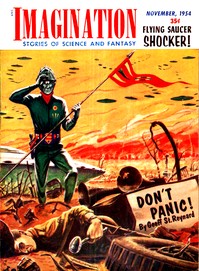
Don't Panic! — Edition Insights
24
3
Project Gutenberg
2021
Science fiction; War stories; Human-alien encounters -- Fiction; Earth (Planet) -- Fiction
Readers of public-domain and historical texts
Project Gutenberg digital edition
en
Edition facts
Words: 23,706
Reading time: 104 min
Text sections: 3
Source:
Project Gutenberg record #66463
Robert W. Krepps's 1955 novella blends alien invasion with media manipulation, as humans use a film about the Third Reich to confuse the Graken. The narrative shifts from bureaucratic reports to desperate improvisation, highlighting the power of spectacle over brute force.
Editorial Edition Score
4.6/5
★★★★★
★★★★★
Calculated from edition completeness, EPUB availability, text structure and catalogue metadata. Not a user rating.
Edition quality
The story opens not with an alien attack but with a detailed history of Air Force policy on flying saucers, written in a detached, reportorial tone. The narrator explains the on-again-off-again release of information as a necessary response to a 'war-nervous, tensed-up population.' This bureaucratic framing gives way to a sudden, visceral shift: the President's jaw drops on live television as the first green alien walks into camera range. The prose accelerates from measured analysis to breathless description, mirroring the public's plunge from skepticism to awe.
From Official Reports to Alien Point of View
The early chapters adopt the voice of a military historian, citing dates and locations—Laredo, Santa Ana, the Capitol—with the precision of a debriefing. Sentences are long, qualified, and cautious: 'the mystery that clouded the strange ships was susceptible of too many interpretations.' Once the Graken appear, the narrative abruptly shifts to their perspective. A passage details their conquest of fifty-one planets, using clinical terms like 'annexation' and 'sub-space.' The tone becomes coldly anthropological, describing how they 'mopped up' native races and kept 'any species that made acceptable food.' This switch in focalization—from human confusion to alien efficiency—creates an unsettling contrast, emphasizing the Graken's systematic ruthlessness.
Improvisation Under Pressure
The middle section, set in a movie theater, changes pace again. Dialogue becomes clipped and urgent. Trace snaps orders—'Roll it! Roll it!'—while Bill fumbles with a projector. The prose sheds its earlier formality, adopting short, action-driven sentences: 'The ten seconds were an eternity; then it was suddenly a chaos of noise.' The plan to screen The Rise and Fall of the Third Reich is a desperate gamble, born from a half-remembered film. Krepps uses the theater setting to literalize the theme of performance: the humans become projectionists, stage-managing an alien audience. The Graken prisoner, Glodd, escapes in the confusion, adding a note of failure to the apparent success.
Voice and the Unreliable Narrator
Throughout the excerpts, the narrative voice oscillates between omniscient authority and limited, fallible human perception. The opening claims the Air Force 'believed in the flying saucers' but then admits the truth was 'susceptible of too many interpretations.' Later, the Graken's backstory is presented as fact, yet it comes from a single prisoner—'whose name was an approximation of the syllable Glodd'—and may be self-serving or incomplete. The narrator never flags this uncertainty, leaving readers to gauge reliability. The final line of the excerpt—'We are sunk'—is contradicted by Trace's hope, creating a tension between despair and ingenuity that the story never fully resolves.
Readers should pay attention to how Krepps uses different registers—bureaucratic, alien, cinematic—to control pacing and mood. The novella's brevity (23,706 words) means these shifts happen quickly, often within a single chapter. The title's command, 'Don't Panic!,' is ironic: the narrative itself panics, then recovers, then panics again. Watch for moments when the voice becomes ironic or self-aware, as when Bill dismisses the film as 'stunk then—about three-fourths of it's old newsreel clips.' Such details hint at a satirical edge beneath the pulp surface.
Reader reflection
Your personal reading reflection
Build a private reading journal entry for this title.
Your progress
0
/
10
2
How much did you enjoy the reading experience?
3
Is this a title you would suggest to others?
4
How much effort did this book require?
5
What was the strongest part of the book?
6
Would you like to discuss this book with someone?
7
How would you describe its reading pace?
8
How did the reading compare with what you expected?
9
In one sentence, what did you learn?
10