1

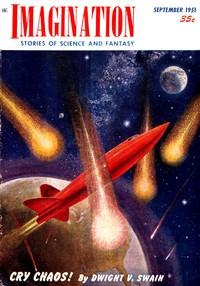
Master Race — Inside the Classic
7
0
Project Gutenberg
2021
Science fiction; Short stories; Boys -- Fiction; Human-alien encounters -- Fiction
Readers of public-domain and historical texts
Project Gutenberg digital edition
en
Edition facts
Words: 6,942
Reading time: 31 min
Text sections: 1
Source:
Project Gutenberg record #65246
In Richard Ashby's 1951 short story, a boy named Eddie encounters mysterious lights and a missing comic book collection, while alien invaders misinterpret Earth's superhero comics as documentary evidence of human power, leading to a comedic retreat.
Editorial Edition Score
4.4/5
★★★★★
★★★★★
Calculated from edition completeness, EPUB availability, text structure and catalogue metadata. Not a user rating.
Edition quality
The story opens with a precise, sensory description of a rural night: a boy named Eddie wakes to his dog Rags whining, and the narrative voice shifts between the boy's limited perspective and an omniscient tone that underlines the dog's 'undercurrent of perplexity and fear.' The prose is deliberate, building tension through small details—the 'muffled thumping of stock' and the 'flittering and high chirping of birds'—before introducing an unnatural sound likened to distant organ music. This careful layering of the ordinary and the strange establishes a quiet, observant voice that will later collide with the aliens' frantic, bureaucratic panic.
Two Registers of Fear
The narrative operates in two distinct emotional registers. Eddie's sections are grounded in a boy's curiosity and bravado: he sneaks out, threatens the tree house with a .22 rifle, and dismisses the lights as 'stars, probably.' His voice is colloquial and unbothered, even after a knock-out. In contrast, the alien Commander's scenes are pitched in escalating hysteria. The prose accelerates with phrases like 'blood drum in his ears' and 'stunned mind at last reeled,' and the aliens' dialogue is formal and exclamatory—'Praise to Law'—as they misread comic books as literal histories. The juxtaposition creates a comedy of errors: the humans are mundane, the aliens are terrified of a fiction they take as fact.
Comic Books as Evidence
The aliens' misunderstanding hinges on a specific set of comic-book titles mentioned in the excerpts: Mandrake The Magician, The Invisible Boys, Buck Rogers, and Bat M (likely Batman). These are not generic 'comics' but named artifacts that the aliens treat as ethnographic records. The eldest alien turns pages showing 'space craft vaster than the one which they occupied' and 'a world being blasted into flaming wreckage.' The story uses these real-world titles to ground its satire in mid-century popular culture. Eddie's missing softball bat and cigarettes are also noted, but the comics are the key: they are the 'evidence' that drives the plot, not the boy's actions.
Pace and the Interdimensional Escape
The story's pace changes sharply when the alien Commander orders 'emergency drive to some far and lost point in space and dimension.' The prose shifts from the slow, sensory buildup of Eddie's night to a compressed, almost breathless description of the ship's escape: 'a shuddering wrench that signalled interdimensional shift,' followed by 'Eternal nothingness of grey enclosed the ship.' This abrupt acceleration mirrors the aliens' panic. The final return to Eddie's morning—'stiff and cold,' finding his things missing—restores the earlier calm, but the reader now knows the stakes the boy never perceives. The pacing thus reinforces the central irony: the humans are oblivious, the aliens are fleeing a phantom threat.
Readers coming to this story should pay attention to how Ashby uses the boy's limited knowledge to create dramatic irony. The aliens' fear is built entirely on misread images, and the text never confirms whether Eddie ever learns the truth. The story rewards a second reading that tracks how each detail—the dog's unease, the missing comics, the 'freshly blown fuse' smell—fits into the aliens' mistaken conclusions. It is a compact, efficient satire of cultural misunderstanding, told through two very different narrative speeds.
Reader reflection
How will you remember this book?
Save your reaction, strongest insight, and memorable passage.
Your progress
0
/
10
2
Was reading this book enjoyable?
3
Is this a title you would suggest to others?
4
Did the language feel accessible?
5
How clear did the writing feel?
6
How valuable was this book for your own interests?
7
Would a second reading be valuable?
8
Did any part of the book feel personally relevant?
9
What is the main idea you are taking away?
10