1

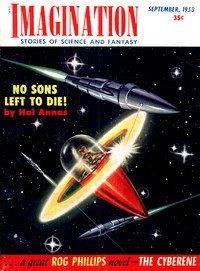
No Sons Left to Die! — Text and Context
12
2
Project Gutenberg
2021
Science fiction; War stories; Man-woman relationships -- Fiction; Human-alien encounters -- Fiction
Readers of public-domain and historical texts
Project Gutenberg digital edition
en
Edition facts
Words: 15,210
Reading time: 67 min
Text sections: 2
Source:
Project Gutenberg record #66155
In a future where galactic war ages boys into cripples within years, Susan Wildress risks death to reunite with spaceman Al. Hal Annas's 1953 story contrasts intimate human longing with the vast, indifferent scale of interstellar conflict.
Editorial Edition Score
4.5/5
★★★★★
★★★★★
Calculated from edition completeness, EPUB availability, text structure and catalogue metadata. Not a user rating.
Edition quality
Hal Annas's 1953 story opens with a concrete, sensory detail: Susan Wildress pushes aside a plate of ground cedar bark, rabbit, and a hydroponic that tastes like eggplant. This ration, served in a tense dining hall of girls, immediately establishes a world of scarcity and surveillance. The narrative voice shifts between Susan's immediate physical sensations—the tight flesh around her eyes, the shiver at overheard words—and her vivid memory of Darth Brady lying about his age to join the war effort. The locket she carries becomes a tangible link to a past that the Centers try to suppress, a private rebellion against a system that forbids close ties between boys and girls.
Contrasts of Scale: The Intimate and the Cosmic
Annas reinforces this contrast through the characters' language. Al's speech about the Creator and love is formal, almost philosophical, yet it is triggered by the most intimate of feelings. Susan's response—moving closer, then asking about the night of the strike—shows her trying to bridge the gap between the cosmic and the personal. The pain in his features when he recalls the boys who died that night reminds the reader that the war is not abstract; it has a human cost that intrudes even into moments of tenderness.
The Weight of Secrecy and Surveillance
This atmosphere of surveillance extends to the characters' knowledge. Susan's roommate asks, Haven't you heard? about Sector Four's movement, implying that information is unevenly distributed. Susan herself does not know the name of Al's ship. The story suggests that even in moments of supposed privacy, the war intrudes: Al's uniform is worn, his temples gray, his eyes carrying the light of long and terrible experience. The personal is never fully separate from the political and military structures that govern their lives.
Temporal Compression: Aging and Urgency
This temporal pressure is reflected in the characters' decisions. Susan sets a wedding date less than two months away, but even that feels long to Al: It's pretty long for an old spaceman. The story's pacing mirrors this compression: scenes shift rapidly from memory to present action, from the dining hall to the groundcar, from quiet conversation to the revelation of Sector Four's movement. The reader, like Susan, is never allowed to rest, always aware that time is running out.
Readers should pay attention to how Annas uses physical objects—the locket, the time card, the groundcar—as anchors for emotional states. The story's power lies not in its speculative war machinery but in the small, precise details of a world where love must be stolen under threat of death. The excerpts leave the full nature of the Zeehites and the war's outcome unclear, but the tension between personal desire and systemic control is fully established from the first page.
Reader reflection
What did you think of this book?
Answer a few questions and save a private reflection on this device.
Your progress
0
/
10
2
What was your overall reaction to the book?
3
Is this a title you would suggest to others?
4
Did the language feel accessible?
5
Did it raise ideas you would like to talk about?
6
How understandable was the text?
7
Did the book meet your expectations?
8
What was the strongest part of the book?
9
In one sentence, what did you learn?
10