1

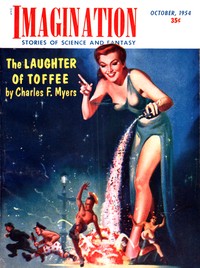
The laughter of Toffee — Reading Notes
14
2
Project Gutenberg
2021
Science fiction; Fantasy fiction; Subconsciousness -- Fiction
Readers of public-domain and historical texts
Project Gutenberg digital edition
en
Edition facts
Words: 25,689
Reading time: 112 min
Text sections: 3
Source:
Project Gutenberg record #66014
Henry Farrell's science-fantasy novella follows ad executive Marc Pillsworth through a spring day that spirals into chaos after a mysterious elixir, a jealous artist, and a gang of criminals converge. The narrative's brisk, sardonic voice and accelerating pace mirror Marc's descent from dyspeptic routine to frenzied crime.
Editorial Edition Score
4.6/5
★★★★★
★★★★★
Calculated from edition completeness, EPUB availability, text structure and catalogue metadata. Not a user rating.
Edition quality
From its first sentence, The Laughter of Toffee announces a narrator who relishes hyperbole: Marc Pillsworth is "striding forward into the first leg of a journey that was destined to take him on a shrieking, streaking sleigh ride of madness, frenzy and crime." The prose is deliberately overwrought, matching the spring fever that infects every character except Marc himself. Farrell builds the story on a foundation of comic irritation—Marc's jealousy of the Italian painter Mario Matalini gives him gas, and his every burp signals a world tilting further off-kilter.
A Voice That Leans Into Exaggeration
The narrator treats Marc's mundane grievances with mock-epic gravity. Spring is personified as a coquette "tossing its golden curls," and Marc's dyspepsia becomes a running gag. The prose is packed with similes and asides that undercut the action even as they propel it. When Marc's wife Julie commissions Mario's portrait, the artist "crooned revoltingly"—the adverb doing double duty as characterization and judgment. This voice never lets the reader forget they are in a comic nightmare, where even a trip to the country is described as a "gaudy flash of inspiration."
Pace as a Reflection of Disorder
The story accelerates through short, punchy dialogue and abrupt scene shifts. Marc's internal monologue—full of burps and gas—gives way to rapid exchanges with the gang that invades his country house. Farrell uses the bus's drunken departure as a visual cue: "the bus started up, lurched crazily forward, shot through the hedge... and took off drunkenly across the lawn." The sentence itself lurches. Later, Toffee's clipped retorts—"You may get lower than you care to, doll"—keep the rhythm staccato, matching Marc's loss of control. The pace mirrors the "shrieking, streaking sleigh ride" promised in the opening.
Recurring Details That Undercut Reality
Farrell plants small, absurd details that accumulate into a surreal texture. Marc's jealousy literally gives him gas—a bodily function that recurs whenever he thinks of Julie and Mario. The caretaker Busby, with his "enormous doubt," speaks in dry understatement that contrasts with the narrator's florid style. When Toffee advises Marc to "take a gun" because "Latin lovers expect jealous husbands to carry guns," the joke lands because it plays on pulp conventions while the story itself is a pulp fantasy. These details keep the reader off-balance, unsure whether the elixir or spring madness is the real cause of chaos.
The Unreliable Normalcy of Marc
Marc presents himself as the only sane man in a world gone silly, but his own actions—hiring a gang, chasing his wife, ignoring the wine-cellar disaster—undermine that claim. The narrator never lets him be a straight man; his dyspepsia and stiff protests are part of the comedy. When he says "I am not jealous, I'm just worried," the reader knows better. This tension between Marc's self-image and his behavior drives the humor and keeps the story from becoming a simple farce.
Readers should pay attention to how Farrell uses the first day of spring as both a plot device and a tonal anchor. The season's "daffiness" excuses the escalating absurdity, but the narrator's consistent voice—sardonic, hyperbolic, and fond of bodily humor—is what gives the story its distinctive texture. Watch how the prose shifts between Marc's internal burps and the gang's rapid-fire banter; the rhythm is the real engine of the tale.
Reader reflection
How will you remember this book?
Save your reaction, strongest insight, and memorable passage.
Your progress
0
/
10
2
Was reading this book enjoyable?
3
Would you encourage someone else to read it?
4
How easy was the book to follow?
5
How would you describe its reading pace?
6
Is this a title worth rereading?
7
How valuable was this book for your own interests?
8
What did you appreciate most?
9
What did this book teach you most?
10