1

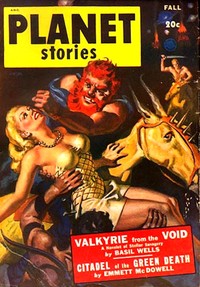
Valkyrie from the Void — Context and Discussion
6
0
Project Gutenberg
2021
Science fiction; Adventure stories; Life on other planets -- Fiction
Readers of public-domain and historical texts
Project Gutenberg digital edition
en
Edition facts
Words: 14,952
Reading time: 66 min
Text sections: 2
Source:
Project Gutenberg record #64725
Basil Wells's 1948 novella follows Hardan Synn, a Dryland caravan leader, and Ylda, a priestess from the Wetlands, as they encounter a stranded alien, Kern Rensom, on the desert planet Osar. The story blends planetary romance with themes of cultural conflict and lost technology.
Editorial Edition Score
4.5/5
★★★★★
★★★★★
Calculated from edition completeness, EPUB availability, text structure and catalogue metadata. Not a user rating.
Edition quality
Basil Wells's Valkyrie from the Void opens not in space but on a river bluff, where the protagonist Hardan Synn reins in his "golden-furred maar" after hunting. The setting is immediately tactile: the heat of a "great ringed sun," garments stuffed with "vurth" padding, and a landscape of "blistering plains." The prose favors concrete, sensory details—the "blue dust" swirling, the "muddy bluish river"—over abstract exposition. This is a world built from specific materials: vurth, a plant fiber used for padding and even roofing a lake; sarifs, the caravan members; and a water dial measuring time. The catalog subjects list "Life on other planets" and "Adventure stories," but the excerpts show a story equally concerned with social hierarchy and the friction between Drylanders and Wetlanders, hinted at in the opening brawl instigated by Nitka Porn.
A World of Vurth and Blue Dust
The excerpts establish Osar through recurring material details. The word "vurth" appears repeatedly: as padding in garments, as a substance that dries out, and later as a "sea" covering a crater lake. This is not mere decoration; the vurth-stuffed clothing is a practical adaptation to the planet's dehydrating conditions. The landscape is consistently described in blues and yellows: "blue clay," "blue ridges," "yellow shale." Even the river is "muddy bluish." The sun is "ringed," a detail that marks the planet as alien without elaborate explanation. Wells uses these recurring elements to build a coherent environment without lengthy infodumps. The reader learns about the world through Hardan's actions—soaking his padded garments, gathering berries—rather than through authorial asides. This technique grounds the adventure in a tangible, if exotic, setting.
Cultural Friction and the Limits of Knowledge
The excerpts reveal a society divided between Drylanders and Wetlanders, each with distinct customs and beliefs. Hardan Synn, a Drylander, leads a caravan of Wetlanders, and the opening fight stems from this tension. The Wetlanders have a pantheon of gods—"Zo Aldan and Ung Roth"—whom they believe came from the outer moons in a "strange metallic ship." Yet when Kern Rensom, an alien from Aarth, arrives, he admits his people have forgotten how to read their own books and cannot repair their technology. This irony undercuts the Wetlanders' religious certainty. Hardan, for his part, is skeptical of both the gods and the devil-things of Wetland belief. The story thus uses the encounter with a stranded alien to question the reliability of cultural memory and the gap between myth and history. The excerpts do not resolve this tension, but they establish it as a central concern.
Voice and Dialogue: Directness and Dialect
Wells's dialogue is brisk and functional, often carrying exposition through argument. Hardan's speech is blunt: "Nitka Porn again," he spits, and later he calls Kern Rensom a "devil-thing." Ylda, the priestess, speaks with a contrasting idealism: "Most of the sarifs are good people." The alien Kern Rensom uses a "blend of Dryland and Wetland speech," a linguistic marker of his outsider status. The narrative voice is similarly direct, favoring short sentences and action verbs: "Hardan sprang off his mount and elbowed his way into the thick of the melee." There is little interiority; emotions are shown through physical reactions—"his slitted green eyes were hot with growing rage." This style suits the pulp adventure format, but it also efficiently conveys character and conflict without slowing the pace. The excerpts suggest a story that moves quickly, with dialogue driving both plot and theme.
Readers approaching Valkyrie from the Void should attend to the way Wells builds his alien world through small, repeated details rather than grand descriptions. The novella's brevity—under 15,000 words—means every element, from the vurth padding to the forgotten books, carries weight. The excerpts leave key questions unanswered: What is Ylda's goal? Will the Aarthmen recover their technology? But the story's interest lies less in resolution than in the friction between cultures and the fragility of knowledge. Treat the catalog subjects as starting points, not summaries.
Reader reflection
Take a moment to reflect on this book
Create a short personal record of your experience with this book.
Your progress
0
/
10
2
How did the book work for you overall?
3
Is this a title you would suggest to others?
4
Did the language feel accessible?
5
How distinctive were its ideas or approach?
6
Would this book work well in a reading group?
7
What did you appreciate most?
8
How would you describe its reading pace?
9
What did this book teach you most?
10