1

Earthmen Die Hard! — Context and Discussion
12
2
Project Gutenberg
2021
Science fiction; Short stories; Human-alien encounters -- Fiction; Earth (Planet) -- Fiction
Readers of public-domain and historical texts
Project Gutenberg digital edition
en
Edition facts
Words: 4,823
Reading time: 21 min
Text sections: 1
Source:
Project Gutenberg record #66312
In Richard O. Lewis's 1954 story, an alien inspector discovers Earth is 'contaminated' despite repeated decontamination. The opening contrasts a romantic Earth couple with the bureaucratic fury of Inspector Ryt, whose body changes color with emotion. The excerpts show a tension between human tenderness and alien sterilization protocols.
Editorial Edition Score
4.4/5
★★★★★
★★★★★
Calculated from edition completeness, EPUB availability, text structure and catalogue metadata. Not a user rating.
Edition quality
The story opens with a human couple on a moonlit hill, arm in arm, looking back at a 'thin needle of metal'—a spaceship. The night wind and blonde curls evoke a tender, almost pastoral scene. Then the narrative cuts abruptly to a 'great ship from beyond the Galaxy' whose inspector, Ryt, peers at Earth and sees lights, checkered patterns, and 'flickering viciously' clouds. His reaction is visceral: he bellows 'Contaminated!' and his 'gross body glow[s] in red anger.' This juxtaposition of romantic intimacy and alien fury sets up the story's central tension.
Emotional Bodies and Alien Bureaucracy
Inspector Ryt's body is a barometer of his mood: it 'glow[s] in red anger,' and his subordinate Krembyl's body 'went pale pink with the shame of defeat,' then 'fading to an ashen gray.' This color-coded physiology externalizes emotion in a way human characters do not. Ryt's fury is directed at Krembyl's failure to keep Sol III sterile, despite reports claiming decontamination. The dialogue is clipped and bureaucratic: 'Your records show Sol III as sterile. Decontaminated!' 'Y-yes, sir... I—I took care of it myself. Just a—a few days ago....' The aliens treat Earth as a problem to be managed, not a world with inhabitants.
The Lens as a Window to Contamination
The lens through which Ryt observes Earth is a key prop. It reveals 'little rows of lights forming checkered patterns' and 'greater lights which flickered viciously among the patterns, leaving squat, circular clouds above them.' These are clearly cities and explosions—evidence of war. The lens does not show humans directly; it shows their artifacts. Ryt's reaction—'And they are warring on each other!'—treats human conflict as a sign of biological infestation. The lens thus mediates between the alien ship and the planet, reducing human activity to data points that confirm contamination.
Repeated Decontamination and Its Failure
Krembyl admits he has 'renovated the planet several times,' yet the contamination persists. He fumbles for a document, saying 'You will find my reports quite in order, sir.' But Ryt dismisses the paperwork: 'Damn the reports! I want to know why this planet hasn't been cared for properly!' This exchange highlights a bureaucratic disconnect: reports claim success, but the lens shows otherwise. The story's title, 'Earthmen Die Hard!,' suggests that humans are resilient, but the excerpts only show the alien side of the conflict. The reader is left to wonder how humans survive repeated sterilization attempts.
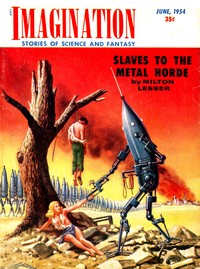
The excerpts provide only the alien perspective on Earth's contamination. The human couple from the opening does not reappear in the supplied text, leaving their fate uncertain. Readers should note that the story was originally published in Imagination Stories of Science and Fantasy in 1954, a period when Cold War anxieties often informed alien-invasion narratives. The tension between bureaucratic order and stubborn human life is the story's engine, but the full resolution—and the meaning of 'die hard'—remains to be discovered.
Reader reflection
How will you remember this book?
Save your reaction, strongest insight, and memorable passage.
Your progress
0
/
10
2
Was reading this book enjoyable?
3
Would you pass this book on to a friend?
4
How demanding did the text feel?
5
Is this a title worth rereading?
6
How personally connected did you feel to the book?
7
How useful were the ideas in this book?
8
How clearly were the main ideas presented?
9
What is the main idea you are taking away?
10