1

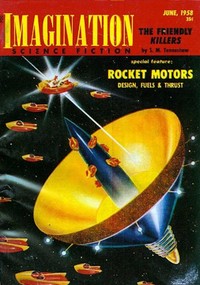
The Friendly Killers — Edition Insights
7
0
Project Gutenberg
2021
Science fiction; War stories; Adventure stories; Human-alien encounters -- Fiction
Readers of public-domain and historical texts
Project Gutenberg digital edition
en
Edition facts
Words: 21,679
Reading time: 95 min
Text sections: 3
Source:
Project Gutenberg record #65283
A FedGov agent on the bastion world Rizal races against time to expose shape-changing Kel infiltrators, but his own security chief dismisses the threat. The opening chapters establish a paranoid, action-driven narrative where invisible enemies may already be in command.
Editorial Edition Score
4.6/5
★★★★★
★★★★★
Calculated from edition completeness, EPUB availability, text structure and catalogue metadata. Not a user rating.
Edition quality
The story opens with agent Traynor emerging from a space-warp chamber on Rizal, a FedGov bastion world, under a thick olive dusk. He has six hours to uncover the truth or face reconditioning. The narrative immediately establishes a countdown and a pervasive sense of paranoia: the enemy Kel are shape-changers who can simulate humans, and their infiltration may already be underway. The prose is lean and kinetic, with short, punchy sentences that mirror Traynor’s urgency. The setting—a transit center with micromesh transistors and a sluggish hatch—grounds the science fiction in tactile, mechanical detail. The excerpt’s opening paragraphs, drawn from a fictional Galactic History, frame the conflict as a two-hundred-year stalemate broken by a recent massacre on Bejak II, but the action quickly shifts to a personal confrontation between Traynor and Controller Kruze.
Voice and Urgency in the Opening
The first-person narration is immediate and breathless. Traynor’s internal monologue is clipped: “I swore under my breath and slammed shut the warp-hatch switch.” The prose favors short, declarative sentences and physical action over exposition. When Traynor attacks the guards, the description is a rapid sequence of blows: “I leaped first, by a split second. … I stomped on his foot and gave him a violent reverse shove.” The voice conveys a man operating on instinct and desperation, not reflection. This style aligns with the story’s pulp origins—first published in Imagination Stories of Science and Fantasy in 1958—but it also serves a thematic purpose: in a world where enemies can mimic human form, quick, unthinking action may be the only reliable response.
The Kel as an Invisible Threat
The catalog subjects list “Human-alien encounters,” but the excerpts show an encounter that is almost entirely indirect. The Kel are never seen; they are described only through their effects: silver globeships, desolated planets, and a two-hundred-year stalemate. The key revelation—that they are “shape-changers” who can “simulate men”—comes from Traynor’s desperate plea to Kruze. The controller’s skepticism (“no human has ever communicated with the Kel”) highlights a central tension: the threat is invisible and unverifiable, making it as much a crisis of belief as of military defense. The story’s title, The Friendly Killers, hints that the real danger may be from within—allies who are not what they seem.
Structure and the Countdown Device
The narrative is built around a tight temporal frame: Traynor has “six Earth hours” to act. This countdown is established in the first paragraph and reinforced by his repeated glances at his chrono. The structure creates a relentless forward momentum, compressing the plot into a race against time. The excerpt also introduces a second structural element: the embedded “Galactic History” excerpt that provides backstory in a detached, academic tone. This contrast between the cold, omniscient history and Traynor’s visceral, first-person account underscores the gap between official records and lived experience. The reader, like Traynor, must piece together the truth from fragmented, unreliable sources.
The excerpts offer only the opening chapters of a novella-length work (about 22,000 words). The central conflict—whether Traynor can prove the Kel infiltration before Kruze silences him—is established but unresolved. Readers should note that the story’s resolution may hinge on the very question of evidence and perception that the opening raises. The text rewards attention to physical detail and the tension between what characters say and what they do.
Reader reflection
Your personal reading reflection
Build a private reading journal entry for this title.
Your progress
0
/
10
2
How much did you enjoy the reading experience?
3
Would you recommend this book to another reader?
4
Did the language feel accessible?
5
How strongly did the book affect you emotionally?
6
What was the strongest part of the book?
7
Did you relate to its people, ideas, or situations?
8
Did you gain anything practical from the text?
9
In one sentence, what did you learn?
10